
A company’s brand can look polished and still feel unclear. The logo may be good, the website modern, the social pages active and the presentations professional. But if each of them tells a slightly different story, the company does not have a strong corporate brand system yet.
That is where a corporate branding agency becomes useful. Corporate branding connects what the company stands for, how it is positioned, how it looks, how it communicates and how people experience it. It covers the organisation’s mission, values and culture as much as its visuals, because all of them shape how stakeholders perceive the business.
At Notion Graffiti, we approach branding alongside strategy, creativity, content, technology and performance, not as an isolated design project. Our process starts with a strategy discussion, moves into full rollout, and then uses performance feedback to adjust and improve the work.
Table of Contents
What Is Corporate Branding?
Corporate branding is the process of shaping how an organisation is understood, recognised and remembered. That includes the company’s:
- positioning
- identity and visual system
- messaging and personality
- communication
- customer-facing experience
- internal brand alignment
It is broader than logo design. A logo identifies the business, while a corporate brand gives that identity meaning and consistency. A company can have a strong logo and still struggle because:
- its value proposition is unclear
- its website speaks differently from its sales team
- different departments use different visual styles
- sub-brands are confusing
- marketing campaigns lack consistency
- employees do not know the core brand message
Corporate branding addresses that larger system.
Corporate Branding vs Brand Identity
These terms are often mixed together, but they are not the same thing.
Brand Identity
Brand identity is the collection of visual and verbal elements used to express the brand: logo, colours, typography, imagery, graphic elements, tone and messaging.
Corporate Branding
Corporate branding is the broader process of creating and managing the organisation’s identity, values and perception.
A simple way to think about it: identity is what the brand uses to express itself. Corporate branding is the system that decides what it should express and how consistently it should appear.
What Does a Corporate Branding Agency Do?
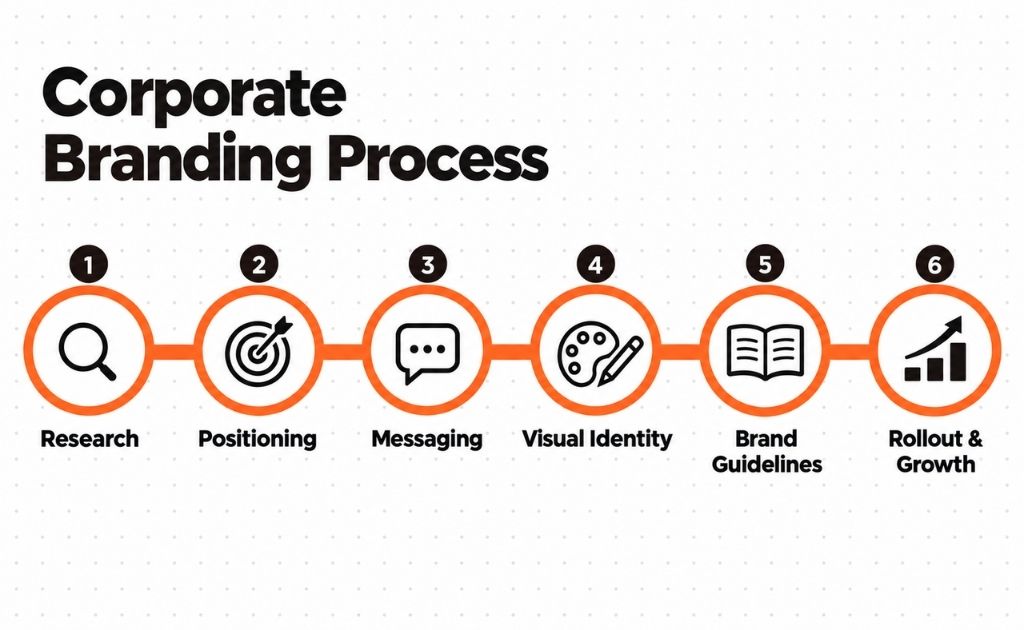
A professional corporate branding agency begins with the business problem, not with design software. The work can include:
- Brand discovery: understanding the business, audience, market and objectives.
- Brand research: studying competitors, category expectations and audience perceptions.
- Positioning: defining how the company should be understood in the market.
- Brand messaging: clarifying the ideas and messages that need to stay consistent.
- Corporate identity: creating or refining the visual identity system.
- Brand architecture: defining the relationship between the company, its products, services and sub-brands.
- Brand guidelines: documenting how the brand should be used.
- Digital brand application: translating the identity into websites, social media, campaigns and content.
- Rollout: helping internal and external teams adopt the new system.
- Ongoing brand management: keeping the brand consistent as the company grows.
Why Corporate Branding Matters for a Growing Company
A small company can often manage its brand informally. The founder makes the decisions, one designer handles most of the work, and everyone knows how the brand should look.
Growth changes that. Suddenly there are more employees, channels, vendors, products, locations, presentations, campaigns and customer touchpoints. Without a system, inconsistency grows with the business.
A corporate branding strategy creates shared rules, so more people can communicate the brand without reinventing it each time.
When Should You Hire a Corporate Branding Agency?
Your company has outgrown its identity
The business has matured, but the brand still looks like an earlier version of the company.
Your brand is inconsistent
Your website, presentations, social profiles and brochures don’t look or sound like they belong to the same organisation.
You have multiple products or services
Customers are struggling to understand how everything fits together.
You’re entering a new market
The current positioning may not work for a new audience or geography.
You’re launching a new business unit
You need to decide whether it should sit under the parent brand or have its own identity.
You’re rebranding
A rebrand requires more than redesigning a logo.
Your business is strong but the presentation feels weak
This is common in B2B and professional-service companies. The capability is there, but the public-facing brand does not communicate that credibility.
Corporate Branding Starts With Research
Good branding should not begin with “Which colour should we use?” It should begin with “What should this company mean to the people who matter?”
A discovery phase may examine:
| Area | What we look at |
|---|---|
| The business | Goals, history, growth plans, strengths, business model, portfolio |
| The audience | Needs, expectations, perceptions, buying triggers, decision criteria |
| The competitors | Positioning, messaging, visual language, points of differentiation |
| The organisation | Leadership perspective, employee understanding, internal communication, existing brand assets |
The purpose is to find the gap between what the company wants to be known for and what the market currently understands.
Corporate Brand Positioning
Positioning answers a simple question: why should someone understand this company differently from its competitors?
Weak positioning usually sounds like “high quality”, “customer focused”, “innovative” or “trusted”. Almost every competitor says the same thing. Strong positioning identifies a meaningful difference and clarifies:
- who the company serves
- what category it operates in
- what problem it solves
- what it does differently
- why that difference matters
Branding becomes much easier once the positioning is clear.
Corporate Brand Messaging
Once the position is clear, the company needs language that can carry it. A messaging framework can define the brand story, core message, value proposition, supporting messages, proof points, elevator pitch, tone of voice and audience-specific messages.
This prevents the common situation where the website says one thing and the sales team says another. The exact words can change by channel, but the core meaning should stay connected.
Corporate Visual Identity
The visual identity translates the strategy into something people can recognise. It can include:
- Logo system: primary mark, alternate versions, clear space, minimum size, background usage.
- Colour system: primary and secondary palettes, with digital and print values.
- Typography: heading hierarchy, body type, digital and presentation use.
- Imagery: photography direction, illustration, iconography, composition.
- Layout system: grids, spacing, hierarchy and recurring visual patterns.
The goal is not to make everything look identical. The goal is to make the brand recognisable and coherent.
Corporate Brand Architecture
Architecture matters most when a company has multiple offerings. Imagine a parent company with a technology division, a healthcare division, a consulting division and a consumer product. How should customers understand those relationships?
Brand architecture provides the structure. It defines the relationship between a master brand, sub-brands, products and service lines. Common models include:
- branded house
- endorsed brands
- house of brands
- hybrid structures
The right model depends on the business, audience overlap, portfolio strategy and the role the corporate brand should play.
Why Brand Architecture Matters
Without clear architecture, businesses create new brands too quickly. Every new service gets a new logo, every product a separate identity, and every acquisition another visual system. Over time, customers struggle to understand what belongs together.
A strong architecture creates clarity for customers, efficiency for marketing, consistency for teams and flexibility for future growth.
Corporate Brand Guidelines
Brand guidelines should be more than a PDF showing logo sizes. A useful brand book can explain:
- brand strategy, positioning and audience
- messaging and tone of voice
- logo rules, colours and typography
- imagery, iconography and layout
- social media and website application
- presentation templates
- examples of correct and incorrect usage
The real goal is usability. A marketing executive should be able to make a social post without asking which colour to use. A salesperson should be able to build a presentation without redesigning the brand. A web developer should know how the identity translates into digital interfaces.
Corporate Branding Across Digital Channels

Corporate branding does not stop at printed stationery. People may encounter a company through Google Search, its website, LinkedIn, Instagram, YouTube, Google Ads, landing pages, email, online reviews and video. The brand needs to feel like the same company across all of them.
This is where corporate branding and digital marketing meet. Because we already run SEO, social media and performance marketing for our clients, digital brand rollout is a natural part of the same system.
Corporate Branding and Website Design
Your website is often the first place a prospect experiences the corporate brand. It should carry the positioning through to the message, the identity and the experience, with consistency in visual hierarchy, colours, typography, imagery, language, CTAs, page structure and trust signals.
A corporate identity becomes far more valuable when it survives the move from a guideline document into a real website. Our web development team builds with the brand system in hand.
Corporate Branding and Social Media
Social media quickly exposes inconsistent branding. One week the posts look premium, the next they use another font, and the week after the tone changes.
That is why the social system should be built on the corporate identity. Our social media marketing and graphic design teams work from the same guidelines, which makes the handoff from brand system to social execution much smoother.
Corporate Branding and Performance Marketing
Paid campaigns should not feel like they belong to a different company. Brand consistency extends to ad creative, landing pages, offers, messaging, retargeting and campaign assets.
The brand does not need to dominate every advertisement, but the audience should still recognise the company behind the message. Our performance marketing service brings paid media and creative together, which helps when awareness and performance need to work side by side.
Corporate Rebranding vs Brand Refresh
| Brand refresh | Rebranding | |
|---|---|---|
| Depth | Updates selected parts of the existing system | Changes the foundations of the brand |
| Typical changes | Typography, colours, logo refinement, photography, layouts, messaging updates | Positioning, audience, identity, architecture, messaging, brand story |
| Brand equity | Preserved | May be rebuilt |
The right answer depends on the business problem. A company should not rebrand simply because its logo looks old. Sometimes the logo is fine and the positioning is the real problem.
Corporate Branding by Company Type
B2B Companies
B2B companies often underestimate branding because the sales process is relationship-driven. But before a buyer speaks to sales, they may already have seen the website, LinkedIn page, case studies, presentation decks, leadership profiles and proposals.
A consistent corporate brand helps communicate credibility, specialisation, scale and professionalism. The brand should support the sales conversation, not fight against it.
Startups and SMEs
Smaller companies do not need unnecessary complexity. A startup may only need clear positioning, a strong identity, practical guidelines and digital application. An established SME may need brand architecture, a communication framework, corporate identity and internal rollout.
The scope should match the stage of the company. Corporate branding should create clarity, not paperwork.
Established Enterprises
Larger organisations have multiple departments, locations, products, acquired brands, agencies and regional teams. The branding challenge becomes governance: how do you let teams move quickly without letting the brand fragment?
That requires guidelines, templates, clear ownership and training.
What Should a Corporate Branding Agency Deliver?
| Stage | Possible deliverables |
|---|---|
| Discovery | Business, audience and competitor research |
| Strategy | Positioning, differentiation, brand direction |
| Messaging | Core message, value proposition, tone of voice |
| Identity | Logo, colour, typography, visual language |
| Architecture | Parent brand, sub-brands and product relationships |
| Guidelines | Brand book and usage standards |
| Digital | Website, social and campaign applications |
| Collateral | Presentations, proposals, stationery and templates |
| Rollout | Internal and external launch support |
| Governance | Ongoing brand consistency framework |
Not every company needs every deliverable. The scope should be built around the actual business problem.
How to Choose a Corporate Branding Agency
Do not choose an agency because it has the most beautiful logo portfolio. Ask deeper questions:
- Do they understand your business? Can they explain the problem before proposing a design?
- Do they start with research? Do they understand your customers and competitors?
- Can they explain positioning? Can they tell you what should make the brand different?
- Do they understand implementation? Can the identity work on a website, presentation, social post and advertisement?
- Can they handle consistency? Do they provide usable guidelines and systems?
- Can they work with your marketing team? A good branding project should make future marketing easier.
Corporate Branding Agency vs Branding Designer
A designer can create an excellent visual identity. A corporate branding agency should go further.
| Branding designer | Corporate branding agency |
|---|---|
| Primarily visual execution | Strategy, identity and implementation |
| Logo and identity | Positioning, identity and messaging |
| Design deliverables | Complete brand system |
| Visual consistency | Organisation-wide consistency |
| Design-focused | Business, customer and communication focused |
Neither is automatically better. If the company already has a clear strategy and simply needs a visual refresh, a designer may be enough. If the company does not know how its brand pieces should fit together, a broader branding partner is the better fit.
How Notion Graffiti Approaches Corporate Branding
We build brands around strategy, creativity and measurable growth, and we don’t separate branding from the rest of your marketing. Our work follows four steps:
- Strategy discussion: we understand your goals, audience and value proposition, backed by research.
- Full rollout: we execute the plan across channels so every element works together.
- Action, learn and adjust: we monitor performance and refine the approach.
- Results: we report on what worked and agree the next steps.
That matters because a corporate brand has to work in the real world. It needs to survive a website redesign, a social campaign, a Google Ad, a sales presentation, a new service, a new employee and a new branch. The brand system should make each of those decisions easier. You can see how this plays out in our case studies.
Corporate Branding Should Make Marketing Easier
A useful corporate branding project reduces uncertainty. Afterwards, your team should know:
- what you stand for and who you are speaking to
- how you look and how you sound
- how your products relate to each other
- how the brand appears online and in campaigns
- how employees should use the identity
That is the real value of a brand system. It should not be another PDF sitting in a shared folder.
When Your Brand Needs More Than a Logo
A logo problem is easy to identify. A corporate branding problem usually runs deeper. You may need broader support when:
- the business or its audience has changed
- the company or its product portfolio has grown
- the existing identity no longer fits
- your communication is inconsistent
- your competitors look more credible
- your employees are not aligned on the message
When several of these happen at once, changing the logo alone will not solve the problem.
Build a Corporate Brand That Can Grow With the Business
The best corporate identity is not the one that looks impressive on launch day. It is the one that keeps working as the company adds products, markets, employees, campaigns and channels.
A good brand system creates enough consistency to build recognition and enough flexibility to keep the business moving. We can bring strategy, creative thinking, digital execution and ongoing optimisation into the same brand-building process.
Frequently Asked Questions
What is a corporate branding agency?
A corporate branding agency helps organisations develop and manage their brand across strategy, positioning, identity, messaging, architecture, guidelines and real-world communication touchpoints.
What services does a corporate branding agency provide?
Services can include brand research, positioning, corporate identity, messaging, brand architecture, brand guidelines, rebranding, digital branding, marketing collateral and brand rollout.
Is corporate branding the same as logo design?
No. A logo is one part of the identity system. Corporate branding covers the broader strategy, identity, communication and experience of the organisation.
What is the difference between corporate branding and brand identity?
Corporate branding is the broader process of shaping and managing how the organisation is perceived. Brand identity is the visual and verbal system used to express that brand.
What is corporate brand strategy?
It is the framework that defines how the company should be positioned, differentiated and communicated to the market.
Does corporate branding include brand guidelines?
It can. A complete project commonly includes guidelines covering identity, visual usage, messaging and applications.
What is corporate brand architecture?
Brand architecture defines the relationships between a company’s corporate brand, sub-brands, products and service lines.
When should a company hire a corporate branding agency?
Consider one when your business is growing, rebranding, entering a new market, launching new business units, managing multiple products or struggling with inconsistent communication.
Do startups need corporate branding?
Yes, but the scope should match their stage. A startup may need clear positioning, identity and messaging, not a large enterprise-level brand programme.
Can a corporate branding agency help with rebranding?
Yes. Depending on the problem, an agency can help with research, positioning, identity, messaging, architecture, guidelines and rollout.
Does corporate branding include digital marketing?
They are different disciplines, but the brand should guide digital marketing across websites, social media, content, advertising and campaigns.
How long does a corporate branding project take?
There is no universal timeline. It depends on research, stakeholder involvement, the number of deliverables, brand architecture and implementation scope.
How much does corporate branding cost in Chennai?
There is no useful single market price. The cost depends on whether the project covers only identity design or a broader engagement including research, strategy, architecture, messaging, guidelines and digital rollout.
How do I choose the best corporate branding agency?
Look at strategic capability, research process, relevant portfolio, identity quality, implementation ability, communication process and whether the agency can help maintain consistency after launch.
Is Your Corporate Brand Ready for the Next Stage?
A strong brand should make the business easier to understand, easier to recognise and easier to trust. Start with the real problem, not just the logo.
Recent Comments