
Quick answer: Digital marketing for manufacturers works as a system, not a single channel. The combination that consistently produces enquiries is a fast, technically sound website, SEO built around the parts, processes and capabilities buyers actually type into Google, paid search on high-intent RFQ keywords, LinkedIn to reach engineering and procurement decision-makers, and email to stay present through long sales cycles. This guide walks through each of those in order, with the metrics to judge them by.
Manufacturing has entered a new era where business growth depends on more than production capacity, product quality, or long-standing industry relationships. While referrals, trade shows, and distributor networks continue to play an important role, today’s buyers increasingly begin their purchasing journey online. Before contacting a supplier or requesting a quotation, they research manufacturers, compare capabilities, evaluate products, and shortlist companies that demonstrate expertise and credibility through their digital presence.
Whether you manufacture industrial machinery, automotive components, precision engineering products, packaging materials, textiles, construction supplies, electrical equipment, or custom industrial solutions, your potential customers are already searching for businesses like yours on Google. If your company isn’t visible when they search, there’s a strong chance those valuable enquiries are reaching your competitors instead.
Digital marketing has become one of the most effective ways for manufacturers to increase brand visibility, generate qualified leads, build trust with decision-makers, and create a consistent pipeline of new business opportunities. Unlike traditional marketing methods that often rely on broad exposure, digital marketing enables manufacturers to reach specific audiences based on their industry, location, buying intent, and search behaviour.
The manufacturing buying process has also evolved significantly. Engineers, procurement managers, plant heads, operations teams, and business owners rarely make purchasing decisions based on a single interaction. Instead, they compare suppliers, read technical content, evaluate websites, review certifications, explore case studies, and assess a company’s expertise before making contact. A well-planned digital marketing strategy helps your business influence these decisions long before the first conversation with your sales team.
In this comprehensive guide, you’ll learn how manufacturers can use search engine optimization (SEO), content marketing, Google Ads, LinkedIn marketing, email campaigns, local SEO, conversion optimization, and AI-powered search strategies to attract more qualified prospects and convert website visitors into long-term customers. We’ll also cover common marketing challenges manufacturers face, practical strategies to overcome them, and the key performance metrics that drive measurable business growth.
At Notion Graffiti, we’ve worked with businesses across multiple industries to improve online visibility, strengthen search performance, and generate meaningful business enquiries. The strategies shared in this guide are based on proven digital marketing principles, industry best practices, and practical implementation—not short-term tactics. Whether you’re a small manufacturing company looking to establish your online presence or an established industrial brand aiming to scale lead generation, this guide will provide a clear roadmap for building sustainable digital growth.
Table of Contents
CHAPTER 01
What Is Digital Marketing for Manufacturers?
Manufacturing companies have traditionally relied on trade shows, dealer networks, referrals, cold outreach, and long-term business relationships to generate sales. While these channels continue to deliver value, today’s purchasing decisions increasingly begin online. Engineers, procurement managers, plant supervisors, project managers, and business owners now use search engines to research suppliers, compare products, evaluate technical capabilities, and shortlist manufacturers before making contact.
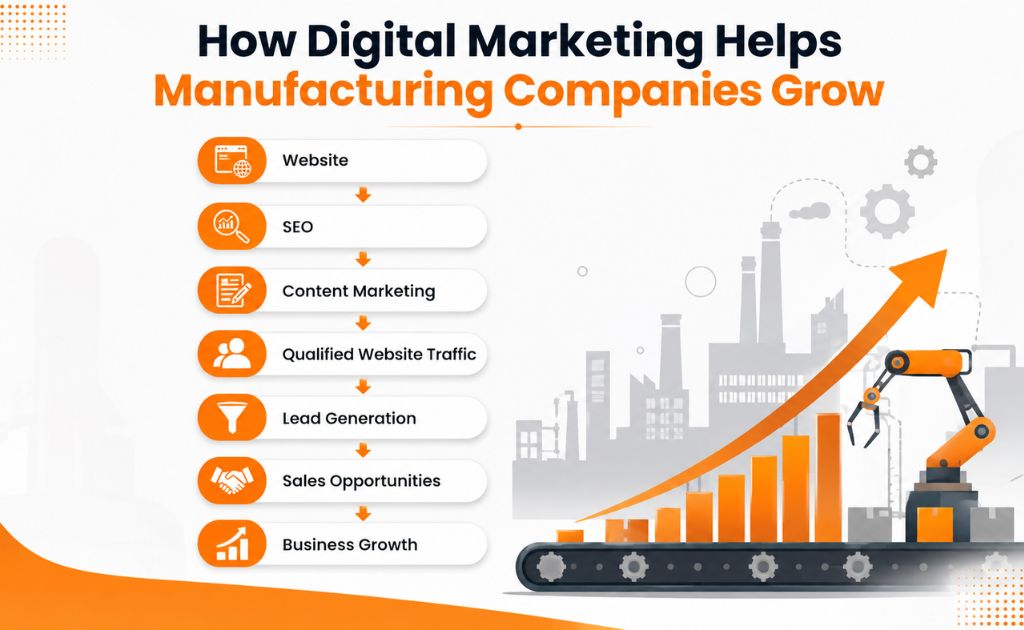
Digital marketing for manufacturers is the process of using digital channels to promote manufacturing businesses, increase online visibility, attract qualified prospects, and generate consistent business enquiries. Rather than waiting for potential customers to discover your company through traditional methods, digital marketing helps you connect with buyers at every stage of their decision-making journey.
An effective manufacturing digital marketing strategy combines multiple channels that work together to build awareness, establish trust, and convert visitors into customers. These include search engine optimization (SEO), content marketing, Google Ads, LinkedIn marketing, email marketing, local SEO, conversion rate optimization, and analytics. When implemented correctly, these strategies create a predictable system for generating high-quality leads and supporting long-term business growth.
Unlike many B2C businesses, manufacturers often deal with complex products, longer sales cycles, and multiple decision-makers. A company purchasing industrial machinery, precision components, or custom-engineered products rarely makes an immediate buying decision. Instead, buyers spend time researching technical specifications, reviewing certifications, comparing suppliers, reading case studies, and evaluating experience before requesting a quotation. Digital marketing ensures your business is visible throughout this research process and positions your company as a trusted industry partner.
Whether you manufacture automotive components, industrial machinery, packaging materials, fabricated products, construction materials, electrical equipment, textiles, chemicals, or custom engineering solutions, your website should do more than showcase products. It should educate potential customers, answer their questions, demonstrate your expertise, and encourage them to take the next step.
What Makes Digital Marketing Different for Manufacturers?
Marketing a manufacturing business requires a different approach than marketing a retail store or an eCommerce brand. Manufacturing buyers focus on technical expertise, production capabilities, certifications, quality standards, pricing, and long-term reliability rather than impulse purchases or promotional offers.
A successful manufacturing marketing strategy is built around providing valuable information that helps buyers make informed decisions. Instead of simply promoting products, manufacturers should publish detailed product pages, technical resources, industry insights, application guides, and case studies that demonstrate real-world expertise.
Digital marketing also enables manufacturers to measure campaign performance, understand customer behaviour, and continuously improve lead generation through data-driven decisions.
Core Digital Marketing Channels for Manufacturers
Most successful manufacturers combine several marketing channels rather than relying on a single source of enquiries.
| Digital Marketing Channel | Primary Goal |
|---|---|
| Search Engine Optimization (SEO) | Increase organic visibility and attract buyers searching on Google |
| Content Marketing | Educate buyers and build industry authority |
| Google Ads | Generate enquiries from high-intent searches |
| LinkedIn Marketing | Reach engineers, procurement teams, and decision-makers |
| Email Marketing | Nurture leads and strengthen customer relationships |
| Local SEO | Improve visibility in regional and industrial searches |
| Conversion Rate Optimization | Turn more website visitors into enquiries |
| Analytics & Reporting | Measure marketing performance and identify growth opportunities |
Benefits of Digital Marketing for Manufacturers
A well-executed digital marketing strategy delivers measurable business benefits beyond website traffic. It helps manufacturers:
- Increase visibility on Google for industry-specific keywords.
- Generate qualified enquiries from businesses actively searching for suppliers.
- Build trust through educational content, certifications, and case studies.
- Reduce dependence on referrals and trade shows alone.
- Reach national and international markets more effectively.
- Improve lead quality by attracting buyers with clear purchase intent.
- Measure marketing performance using real-time data and analytics.
- Create a scalable system for consistent lead generation and business growth.
CHAPTER 02
Why Manufacturers Need Digital Marketing in 2026
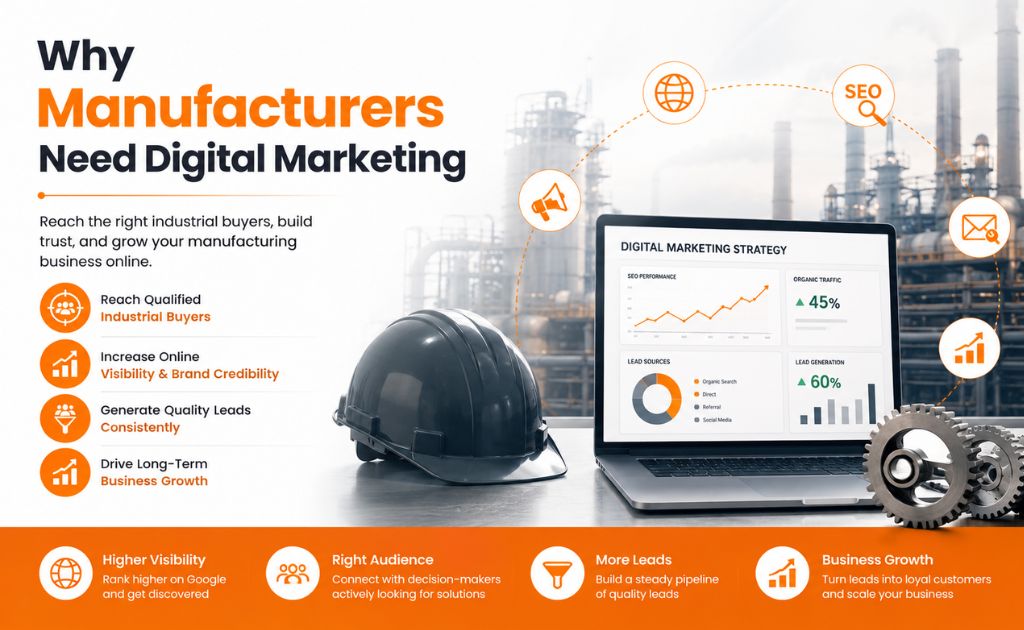
Manufacturing has become more competitive than ever before. Buyers are no longer limited to local suppliers or recommendations from industry contacts. With access to search engines, online marketplaces, social platforms, and AI-powered search tools, businesses can compare manufacturers across regions and even countries before making an enquiry. For manufacturers that want to remain competitive, having a strong digital presence is no longer optional—it’s an essential part of business growth.
Modern manufacturing buyers expect more than a catalogue and a contact number. They want to understand your capabilities, production standards, certifications, previous projects, and industry expertise before they reach out. If your business isn’t visible during this research phase, potential customers are likely to choose a competitor who provides the information they’re looking for.
Digital marketing enables manufacturers to reach decision-makers earlier in the buying journey, educate them with valuable content, and build confidence before the first conversation with the sales team. Instead of depending only on referrals or exhibitions, manufacturers can create a reliable system for generating qualified enquiries throughout the year.
Whether your business serves domestic clients or exports products internationally, digital marketing helps you increase visibility, strengthen your brand, and connect with buyers who are actively searching for manufacturing solutions.
Manufacturing Buyers Begin Their Search Online
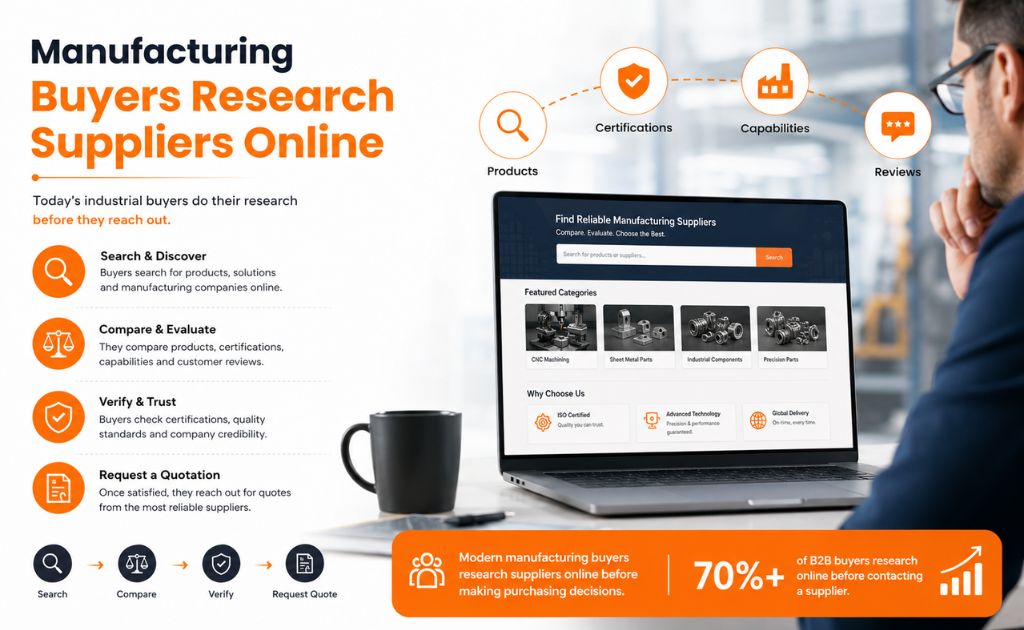
The manufacturing buying process has changed significantly over the last decade. Engineers, procurement managers, project managers, and business owners typically start with online research before contacting suppliers. They search for products, compare technical capabilities, review certifications, and evaluate manufacturers based on the information available online.
A manufacturer with a fast, informative, and search-optimized website is far more likely to earn trust than one with limited or outdated online information.
Digital Transformation Has Changed the Manufacturing Industry
Manufacturing businesses are increasingly adopting digital technologies across production, supply chain management, and customer communication. Marketing should evolve alongside these changes.
Digital marketing supports this transformation by helping manufacturers:
- Showcase products and capabilities online
- Reach new domestic and international markets
- Build credibility through educational content
- Generate enquiries beyond traditional sales channels
- Measure marketing performance with accurate data
Businesses that embrace digital marketing are better positioned to adapt to changing customer expectations and market conditions.
Generate Qualified Leads Instead of Just Website Traffic
Website traffic alone doesn’t grow a manufacturing business. The real objective is attracting visitors who have genuine purchasing intent.
Through SEO, content marketing, Google Ads, and well-designed landing pages, manufacturers can attract prospects who are actively looking for products or services they offer. These visitors are more likely to request quotations, download catalogues, or contact the sales team, resulting in higher-quality leads and better conversion rates.
Build Trust Before the First Sales Conversation
Manufacturing purchases often involve significant investments and long decision-making cycles. Buyers want confidence that they’re choosing a reliable supplier.
A strong digital presence helps establish credibility through:
- Detailed product information
- Industry certifications
- Customer testimonials
- Case studies
- Factory images and videos
- Technical resources
- Frequently asked questions
When buyers find useful, transparent information, they are more likely to trust your business and move forward with an enquiry.
Expand Beyond Local Markets
Digital marketing removes geographical limitations. With effective SEO and targeted campaigns, manufacturers can reach customers across India or in international markets without opening new physical offices.
Whether you’re targeting OEMs, distributors, wholesalers, contractors, or industrial buyers, a well-planned digital strategy allows your business to compete in wider markets and generate enquiries from regions where you previously had little visibility.
Measure Marketing Performance with Real Data
Unlike many traditional marketing methods, digital marketing provides measurable insights that help manufacturers make informed business decisions.
Important metrics include:
- Organic website traffic
- Keyword rankings
- Qualified enquiries
- Cost per lead
- Conversion rate
- Quote requests
- Return on investment (ROI)
By analysing these metrics regularly, manufacturers can refine their marketing strategy and allocate budgets more effectively.
| Traditional Manufacturing Marketing | Digital Marketing for Manufacturers |
|---|---|
| Trade shows and exhibitions | SEO and organic search visibility |
| Cold calling | Content-driven lead generation |
| Print advertisements | Google Ads and online campaigns |
| Distributor referrals | Website enquiries and contact forms |
| Limited performance tracking | Real-time analytics and measurable ROI |
| Local reach | National and international visibility |
CHAPTER 03
Understanding the Modern Manufacturing Buyer’s Journey
The manufacturing buying journey is far more complex than a typical consumer purchase. Industrial products and services often involve higher investments, longer sales cycles, technical evaluations, and multiple stakeholders. Before requesting a quotation or contacting a supplier, buyers spend considerable time researching solutions, comparing manufacturers, and validating whether a company can meet their specific requirements.
Today’s buyers expect manufacturers to provide more than product information. They look for detailed specifications, industry expertise, certifications, case studies, customer success stories, and evidence of quality. A strong digital presence helps manufacturers answer these questions at every stage of the buying journey, making it easier for potential customers to trust their business and move forward with confidence.
Understanding how manufacturing buyers search, evaluate, and select suppliers allows businesses to create digital marketing strategies that deliver the right information at the right time, ultimately increasing enquiries and improving conversion rates.
Stage 1: Problem Recognition
Every buying journey begins when a business identifies a need. This could involve replacing outdated machinery, sourcing a new component supplier, increasing production capacity, improving product quality, or reducing manufacturing costs. At this stage, buyers begin searching online to understand available solutions and identify potential suppliers.
Manufacturers that publish educational content, industry insights, and solution-focused pages are more likely to appear during these early searches, helping them build awareness before competitors.
Stage 2: Research and Information Gathering
Once buyers define their requirements, they begin researching manufacturers that offer the products or services they need. They compare company websites, product specifications, certifications, manufacturing capabilities, pricing models, and customer reviews to create a shortlist of potential suppliers.
A well-optimized website with clear navigation, detailed product pages, downloadable brochures, and helpful resources improves the user experience and encourages buyers to continue exploring your business.
Stage 3: Supplier Evaluation
After creating a shortlist, buyers evaluate each manufacturer based on expertise, production capacity, quality standards, delivery capabilities, certifications, customer support, and previous project experience.
Manufacturers can strengthen buyer confidence by showcasing:
- Product certifications
- Manufacturing facilities
- Case studies
- Client testimonials
- Industry experience
- Quality assurance processes
- Factory images and videos
Providing transparent information reduces uncertainty and positions your company as a reliable manufacturing partner.
Stage 4: Request for Quotation (RFQ)
Once buyers identify suitable suppliers, they submit enquiries or request quotations. At this stage, your website should make it easy to contact your team through enquiry forms, downloadable catalogues, phone numbers, email addresses, or WhatsApp.
A simple and user-friendly enquiry process increases the likelihood of converting interested visitors into qualified sales opportunities.
Stage 5: Purchase Decision
The final decision often depends on several factors, including pricing, product quality, technical support, production timelines, communication, and trust. Manufacturers that consistently demonstrate professionalism throughout the buyer journey are more likely to win new business.
Digital marketing supports this stage by reinforcing your company’s credibility through valuable content, positive customer experiences, and a professional online presence.
Stage 6: Customer Retention and Repeat Business
The relationship doesn’t end after the first order. Successful manufacturers continue engaging customers through email marketing, product updates, technical resources, after-sales support, and ongoing communication. This strengthens customer loyalty, encourages repeat orders, and generates referrals.
Retaining existing customers is often more cost-effective than acquiring new ones, making customer relationship management an essential part of every manufacturing marketing strategy.
Buyer’s Journey Table
| Buyer Stage | Customer Goal | Recommended Digital Marketing Strategy |
|---|---|---|
| Problem Recognition | Identify a solution | SEO, educational blogs, industry guides |
| Research | Compare suppliers | Product pages, technical content, videos |
| Evaluation | Assess credibility | Case studies, certifications, testimonials |
| RFQ | Request pricing | Landing pages, enquiry forms, CTAs |
| Purchase | Choose a supplier | Sales support, trust signals, follow-ups |
| Retention | Continue the relationship | Email marketing, customer support, newsletters |
CHAPTER 04
Common Marketing Challenges Manufacturers Face
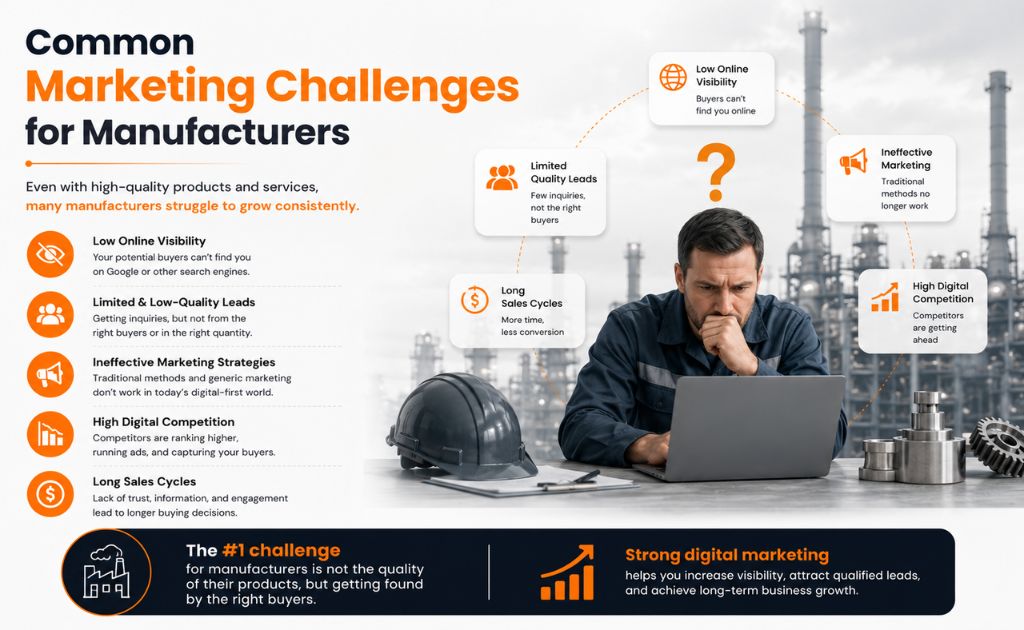
Many manufacturing companies produce high-quality products and have years of industry experience, yet they struggle to generate a consistent flow of qualified enquiries. In many cases, the challenge isn’t the product or service itself—it’s the lack of visibility in an increasingly digital marketplace.
Traditional marketing methods such as referrals, trade shows, and dealer networks still have value, but they rarely provide a predictable source of new business on their own. Today’s buyers research suppliers online, compare multiple manufacturers, and expect detailed information before making contact. Without a strong digital marketing strategy, even established manufacturers can lose opportunities to competitors with a better online presence.
Understanding these challenges is the first step toward building a marketing strategy that attracts the right audience, generates qualified leads, and supports long-term business growth.
Limited Online Visibility
If potential customers can’t find your business on Google, they are unlikely to consider your company during the supplier evaluation process. Many manufacturers have websites that receive very little organic traffic because they lack search engine optimization, targeted content, and industry-focused landing pages.
Improving online visibility through SEO, technical website optimization, and relevant content helps your business appear when buyers search for manufacturing products and services.
Dependence on Referrals and Traditional Sales Channels
Many manufacturers rely heavily on referrals, repeat customers, exhibitions, and personal relationships to generate enquiries. While these channels remain valuable, they often produce inconsistent results and make business growth difficult to predict.
Digital marketing creates an additional lead generation channel that works continuously, helping manufacturers attract new customers without depending solely on existing networks.
Difficulty Generating Qualified Leads
High website traffic doesn’t always result in business enquiries. Many manufacturers attract visitors who aren’t actively looking for their products or services, leading to poor conversion rates.
A targeted digital marketing strategy focuses on attracting buyers with genuine purchase intent through keyword research, SEO, content marketing, and optimized landing pages.
Long and Complex Sales Cycles
Manufacturing purchases often involve multiple stakeholders, technical evaluations, budget approvals, and supplier comparisons. As a result, sales cycles can take weeks or even months.
Digital marketing supports buyers throughout this process by providing educational content, product documentation, case studies, and follow-up communication that keeps your business top of mind until a purchasing decision is made.
Outdated or Poorly Optimized Websites
Your website is often the first impression potential customers have of your business. A slow, outdated, or difficult-to-navigate website can reduce trust and discourage visitors from making an enquiry.
Modern manufacturing websites should be:
- Fast and mobile-friendly
- Easy to navigate
- Optimized for search engines
- Rich in technical product information
- Designed with clear calls to action
- Built to convert visitors into enquiries
Increasing Competition in the Manufacturing Industry
Manufacturers today compete not only with local businesses but also with national and international suppliers. Companies investing in SEO, Google Ads, content marketing, and digital branding are capturing more market share and reaching buyers earlier in the decision-making process.
Businesses that delay digital transformation risk losing visibility and valuable opportunities to more digitally mature competitors.
Measuring Marketing Performance
Without accurate data, it’s difficult to know which marketing activities generate results. Many manufacturers struggle to measure website traffic, enquiry sources, conversion rates, and return on investment.
Using tools such as Google Analytics, Google Search Console, and CRM reporting allows manufacturers to track performance, understand customer behavior, and continuously improve their marketing strategy.
Comparison Table
| Marketing Challenge | Digital Marketing Solution |
|---|---|
| Low online visibility | Search Engine Optimization (SEO) |
| Dependence on referrals | Multi-channel lead generation |
| Poor website conversions | Conversion Rate Optimization (CRO) |
| Limited brand awareness | Content marketing and social media |
| Long sales cycle | Lead nurturing and email marketing |
| Unclear marketing ROI | Analytics and performance reporting |
CHAPTER 05
The Complete Digital Marketing Strategy for Manufacturers
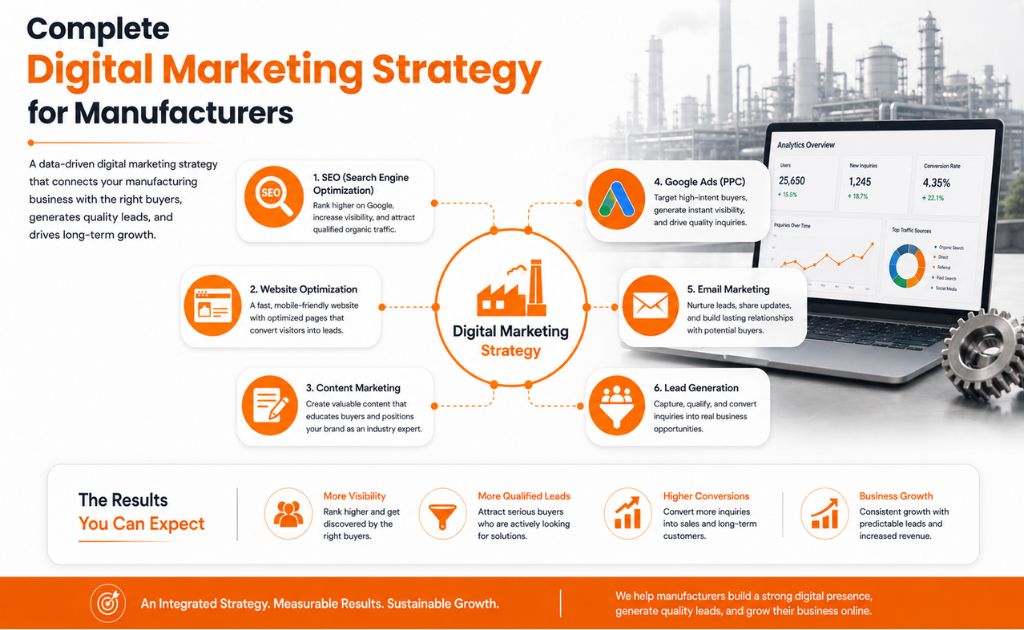
Successful manufacturing companies don’t rely on a single marketing channel to generate enquiries. Instead, they build an integrated digital marketing strategy where every channel works together to increase visibility, attract qualified buyers, and convert prospects into long-term customers.
A modern manufacturing marketing strategy begins with a professional website that clearly communicates your products, capabilities, certifications, and industry expertise. From there, search engine optimization (SEO), content marketing, paid advertising, social media, and email marketing help drive targeted traffic while conversion optimization ensures more visitors become qualified enquiries.
Rather than focusing only on generating website traffic, manufacturers should build a marketing ecosystem that supports buyers throughout every stage of their purchasing journey. This approach improves lead quality, shortens sales cycles, strengthens customer relationships, and creates predictable business growth.
The following digital marketing channels form the foundation of a successful manufacturing marketing strategy.
Website Optimization
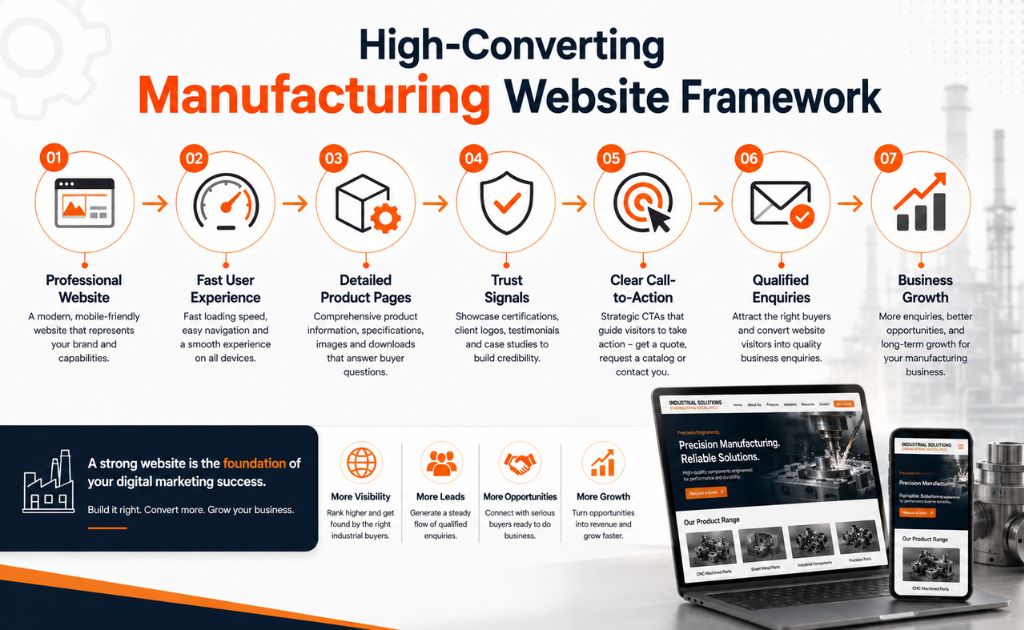
Your website is the foundation of every digital marketing activity. It should provide a professional user experience, load quickly across all devices, showcase products and services clearly, and make it easy for buyers to contact your business.
A well-optimized manufacturing website builds trust, improves search visibility, and supports lead generation by guiding visitors toward enquiry forms, quotation requests, or consultation bookings.
Search Engine Optimization (SEO)
Search Engine Optimization helps manufacturers appear in Google when buyers search for products, services, or industry solutions.
By optimizing website content, technical performance, product pages, and industry-specific keywords, SEO attracts high-intent visitors who are actively looking for manufacturing partners. Unlike paid advertising, SEO continues delivering long-term visibility and qualified organic traffic.
Content Marketing
Manufacturing buyers expect detailed information before making purchasing decisions. Publishing educational blogs, buying guides, technical resources, product comparisons, case studies, and industry insights demonstrates expertise while helping potential customers solve problems.
High-quality content also supports SEO by increasing topical authority and improving visibility across relevant search queries.
Google Ads
Google Ads enables manufacturers to reach buyers who are actively searching for products or services. Search campaigns place your business at the top of relevant search results, helping generate enquiries while supporting long-term SEO efforts.
Paid advertising is particularly effective for launching new products, targeting competitive keywords, and generating immediate visibility.
LinkedIn Marketing
LinkedIn is one of the most effective platforms for reaching procurement managers, engineers, operations leaders, business owners, and other B2B decision-makers.
Sharing industry knowledge, company updates, success stories, and technical expertise helps manufacturers build credibility while strengthening professional relationships.
Email Marketing
Email marketing keeps your business connected with prospects and existing customers throughout the buying cycle. Automated follow-ups, newsletters, product updates, and educational resources help nurture leads until they are ready to make a purchasing decision.
Conversion Rate Optimization (CRO)
Generating website traffic is only part of the process. Manufacturers also need to convert visitors into qualified enquiries.
Conversion Rate Optimization focuses on improving enquiry forms, call-to-action buttons, landing pages, trust signals, and user experience to increase the percentage of visitors who contact your business.
Marketing Analytics
Every marketing strategy should be guided by data. Analytics tools help manufacturers understand where enquiries originate, which campaigns generate the highest return on investment, and how visitors interact with the website.
Regular performance analysis allows businesses to improve campaigns, allocate budgets more effectively, and make informed marketing decisions.
Comparison Table
| Marketing Channel | Primary Objective | Business Impact |
|---|---|---|
| Website Optimization | Improve user experience | Higher enquiry rates |
| SEO | Increase organic visibility | Long-term qualified traffic |
| Content Marketing | Build trust and authority | Better buyer engagement |
| Google Ads | Generate immediate enquiries | Fast lead generation |
| LinkedIn Marketing | Reach B2B decision-makers | Brand credibility |
| Email Marketing | Nurture prospects | Repeat business and conversions |
| CRO | Improve enquiry rates | More qualified leads |
| Analytics | Measure performance | Better marketing decisions |
CHAPTER 06
Website Optimization for Manufacturing Companies
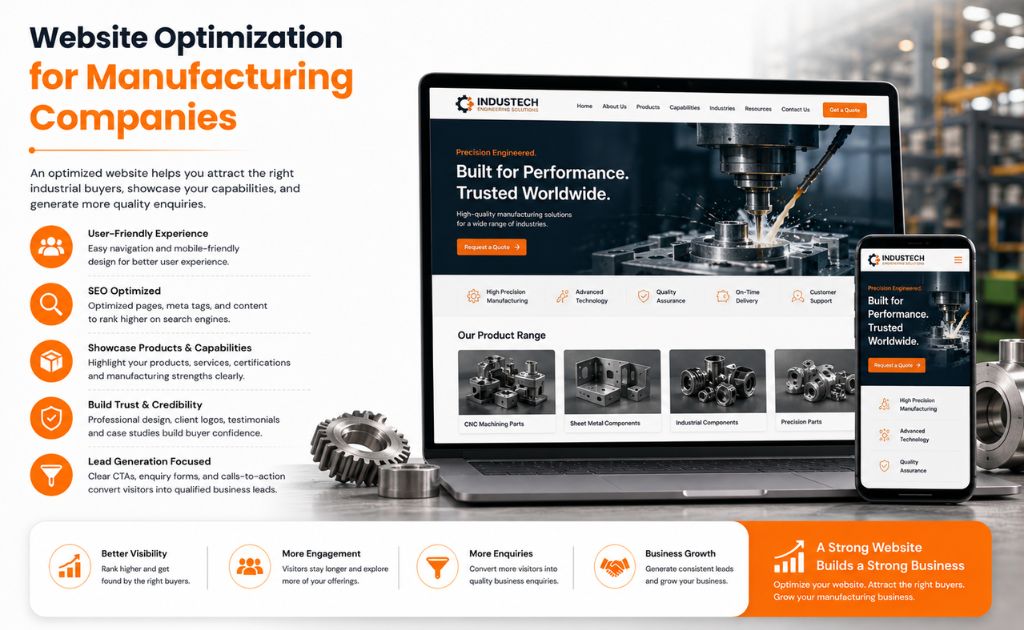
Your website is more than an online brochure—it’s often the first interaction a potential customer has with your business. Before contacting your sales team, manufacturing buyers visit your website to evaluate your products, capabilities, certifications, production standards, and overall credibility. A professional, well-optimized website helps build trust, answer buyer questions, and encourage enquiries.
An effective manufacturing website should not only look modern but also support your business goals. It should load quickly, provide a seamless experience across all devices, and guide visitors toward requesting a quotation, downloading product information, or contacting your team. When combined with SEO and conversion optimization, your website becomes one of your most valuable lead generation assets.
Manufacturers with fast, informative, and user-friendly websites are better positioned to attract qualified buyers, improve search visibility, and convert website visitors into long-term customers.
Create a Professional First Impression
First impressions matter. A professionally designed website reflects the quality, reliability, and expertise of your manufacturing business. Buyers expect clear navigation, consistent branding, and detailed information that helps them evaluate your company.
Include essential trust-building elements such as:
- Company overview
- Manufacturing capabilities
- Product catalogue
- Industry certifications
- Quality assurance standards
- Client testimonials
- Case studies
- Contact information
A clear and professional presentation increases buyer confidence and encourages further engagement.
Showcase Products and Manufacturing Capabilities
Your website should clearly explain what you manufacture, the industries you serve, and the unique value your business offers. Each product or service should have a dedicated page with detailed descriptions, specifications, applications, and high-quality images.
Where applicable, include:
- Technical specifications
- Material options
- Product dimensions
- Manufacturing processes
- Industry applications
- Frequently asked questions
- Downloadable brochures or catalogues
This helps buyers evaluate your solutions while improving your visibility for industry-specific search terms.
Improve Website Speed and Mobile Performance
Website performance directly impacts both user experience and search rankings. Buyers expect pages to load quickly regardless of the device they use. Slow-loading websites can increase bounce rates and reduce enquiry opportunities.
Best practices include:
- Optimized images
- Fast web hosting
- Clean website code
- Browser caching
- Mobile-responsive design
- Core Web Vitals optimization
A fast website improves both customer satisfaction and SEO performance.
Make It Easy to Request a Quote
One of the primary goals of a manufacturing website is to convert visitors into enquiries. Every important page should include clear calls to action that encourage visitors to request pricing, download catalogues, or contact your sales team.
Examples include:
- Request a Quote
- Get a Free Consultation
- Download Product Catalogue
- Contact Our Sales Team
Simple enquiry forms and visible contact information reduce friction and improve conversion rates.
Build Trust with Social Proof
Manufacturing buyers want reassurance before choosing a supplier. Demonstrating your experience and reliability through real-world proof strengthens buyer confidence.
Effective trust signals include:
- Customer testimonials
- Case studies
- Industry certifications
- ISO compliance
- Years of experience
- Manufacturing facility photos
- Client logos
- Awards and recognitions
These elements help differentiate your business and support purchasing decisions.
Optimize Every Page for Search Engines
A visually appealing website alone isn’t enough. Every page should also be optimized to help search engines understand your content and improve its visibility.
Focus on:
- Keyword-optimized page titles
- Meta descriptions
- Heading hierarchy
- Internal linking
- Optimized images
- Structured data (Schema)
- Descriptive URLs
Combining strong SEO with an excellent user experience ensures your website attracts qualified traffic while converting more visitors into leads.
Best Practices Checklist
| Website Optimization Area | Best Practice |
|---|---|
| Website Speed | Load pages in under 3 seconds |
| Mobile Experience | Fully responsive across all devices |
| Navigation | Clear menus and logical page structure |
| Product Pages | Detailed descriptions and specifications |
| Contact Forms | Simple, easy-to-complete enquiry forms |
| Trust Signals | Certifications, testimonials, client logos |
| SEO | Optimized titles, headings, and metadata |
| Security | SSL certificate and secure browsing |
CHAPTER 07
SEO for Manufacturers: Increase Online Visibility and Generate Qualified Leads
Search Engine Optimization (SEO) is one of the most effective long-term digital marketing strategies for manufacturing companies. Unlike paid advertising, which stops generating traffic once your budget is exhausted, SEO helps your business earn consistent visibility in search results by improving the quality, relevance, and technical performance of your website.
Every day, engineers, procurement managers, distributors, contractors, and business owners search online for manufacturing products, suppliers, industrial solutions, and technical information. If your website appears prominently when these searches happen, you have a greater opportunity to attract qualified visitors who are actively looking for the products or services you offer.
A successful manufacturing SEO service and strategy goes beyond ranking for a few keywords. It focuses on understanding buyer intent, optimizing product and service pages, publishing valuable content, improving website performance, and building authority within your industry. Together, these efforts increase organic traffic, strengthen credibility, and generate enquiries that contribute to long-term business growth.
Why SEO Matters for Manufacturing Companies
Manufacturing buyers rely heavily on search engines during the supplier selection process. They compare manufacturers, evaluate technical capabilities, review product specifications, and research industry expertise before making purchasing decisions.
SEO helps manufacturers become visible at these critical moments by ensuring their website appears for relevant searches. Instead of relying solely on referrals or outbound sales, manufacturers can attract qualified buyers who are already searching for solutions online.
Benefits of SEO for manufacturers include:
- Increased visibility on Google
- Higher-quality website traffic
- More qualified business enquiries
- Stronger brand authority
- Reduced dependence on paid advertising
- Long-term return on investment
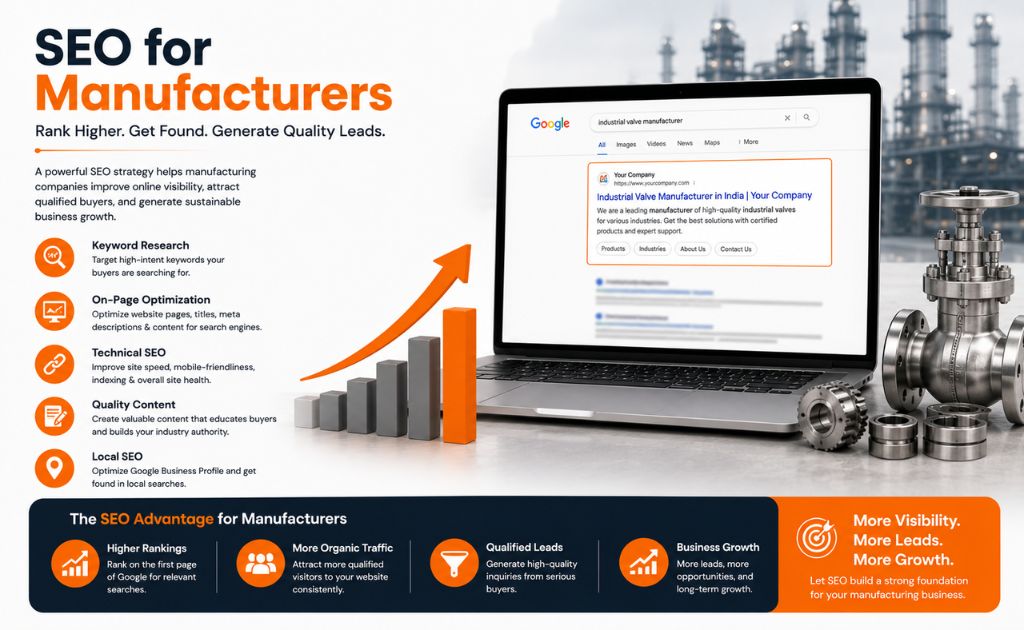
Keyword Research for Manufacturing Businesses
Keyword research is the foundation of every successful SEO campaign. Rather than targeting only broad industry terms, manufacturers should focus on the phrases their ideal customers actually use during different stages of the buying journey.
Examples include:
- Product keywords
- Service keywords
- Industry-specific keywords
- Application-based keywords
- Location-based keywords
- Informational search queries
By understanding search intent, manufacturers can create content that answers buyer questions while attracting highly relevant traffic.
On-Page SEO
Every page on your website should be optimized to help both users and search engines understand its purpose.
This includes:
- SEO-friendly page titles
- Compelling meta descriptions
- Clear heading hierarchy (H1, H2, H3)
- Keyword-rich product descriptions
- Internal linking
- Optimized images
- Descriptive URLs
Strong on-page SEO improves search visibility while enhancing the user experience.
Technical SEO
Technical SEO ensures your website is easy for search engines to crawl, index, and understand.
Important technical factors include:
- Fast loading speed
- Mobile responsiveness
- Secure HTTPS connection
- XML sitemap
- Robots.txt
- Canonical URLs
- Structured data
- Core Web Vitals
A technically optimized website provides a better experience for both users and search engines.
Local SEO for Manufacturers
Many manufacturers serve specific cities, industrial corridors, or regional markets. Local SEO helps businesses appear in location-based searches and Google Maps, making it easier for nearby customers to discover their services.
Local SEO includes:
- Google Business Profile optimization
- Local landing pages
- Business citations
- Customer reviews
- Location-based keywords
- Consistent business information
For manufacturers with multiple branches or service areas, dedicated location pages can significantly improve local visibility.
Product Page SEO
Product pages are often the first pages buyers visit after searching online. Every product page should provide complete, useful information that answers buyer questions and demonstrates expertise.
Include:
- Detailed product descriptions
- Technical specifications
- Industry applications
- Product images
- Frequently Asked Questions
- Certifications
- Downloads
- Clear enquiry buttons
Optimized product pages improve rankings while increasing conversion opportunities.
Content Marketing and Topical Authority
Publishing valuable content helps manufacturers establish expertise while improving search rankings.
Examples include:
- Industry blogs
- Buying guides
- Product comparisons
- Technical resources
- Case studies
- Industry trends
- Maintenance guides
- Frequently Asked Questions
A consistent content strategy strengthens topical authority and increases opportunities to rank for a wider range of search queries.
Image SEO
Manufacturing websites often contain hundreds of product images. Optimizing these images improves both accessibility and search performance.
Best practices include:
- Descriptive file names
- Keyword-focused alt text
- Optimized image sizes
- WebP format
- Image captions
- Structured image data
Image SEO also increases the chances of appearing in Google Images.
AI Search Optimization
Search behaviour continues to evolve with AI-powered search experiences.
To improve visibility in AI-generated answers:
- Publish comprehensive content
- Answer common questions clearly
- Use structured headings
- Add FAQ sections
- Implement schema markup
- Demonstrate expertise with original insights
- Keep content accurate and up to date
Creating genuinely helpful content improves visibility in both traditional search results and AI-assisted search experiences.
SEO Checklist
| SEO Area | Best Practice |
|---|---|
| Keyword Research | Target commercial and informational intent |
| On-Page SEO | Optimize titles, headings, and metadata |
| Technical SEO | Improve speed, indexing, and Core Web Vitals |
| Local SEO | Optimize Google Business Profile and location pages |
| Product SEO | Create detailed, keyword-focused product pages |
| Content Marketing | Publish valuable industry content consistently |
| Image SEO | Optimize filenames, alt text, and image size |
| Internal Linking | Connect related service and blog pages |
| Schema Markup | Add structured data for better search understanding |
| Analytics | Measure rankings, traffic, and conversions |
CHAPTER 08
Content Marketing for Manufacturers: Build Trust, Authority, and Generate Qualified Leads
Content marketing is one of the most valuable investments a manufacturing company can make to support long-term business growth. Unlike traditional advertising, which focuses on promoting products, content marketing helps manufacturers educate potential buyers, answer technical questions, and demonstrate industry expertise throughout the purchasing journey.
Today’s manufacturing buyers don’t make decisions based on a single advertisement or sales call. They research products, compare suppliers, review technical specifications, and seek reliable information before requesting a quotation. Publishing relevant, high-quality content helps your business become a trusted resource while improving search engine visibility and attracting qualified organic traffic.
A well-planned content marketing strategy not only supports SEO but also helps manufacturers build credibility, nurture prospects, and generate consistent business enquiries.
Create Content That Solves Buyer Problems
Successful manufacturing content focuses on answering real customer questions rather than simply promoting products. Buyers are searching for solutions to specific challenges, and your content should help them make informed decisions.
Examples include:
- Product selection guides
- Industry best practices
- Material comparison articles
- Manufacturing process explanations
- Maintenance and troubleshooting guides
- Frequently asked questions
Educational content positions your company as an industry expert and builds confidence before the sales conversation begins.
Publish Industry-Focused Blog Articles
A regularly updated blog allows manufacturers to target informational search queries while expanding their topical authority.
Useful blog topics include:
- Industry trends
- Manufacturing innovations
- Product applications
- Technical insights
- Buying guides
- Compliance and certification updates
- Maintenance tips
- Cost-saving strategies
Consistent blogging helps your website rank for a broader range of keywords while attracting buyers during the research stage.
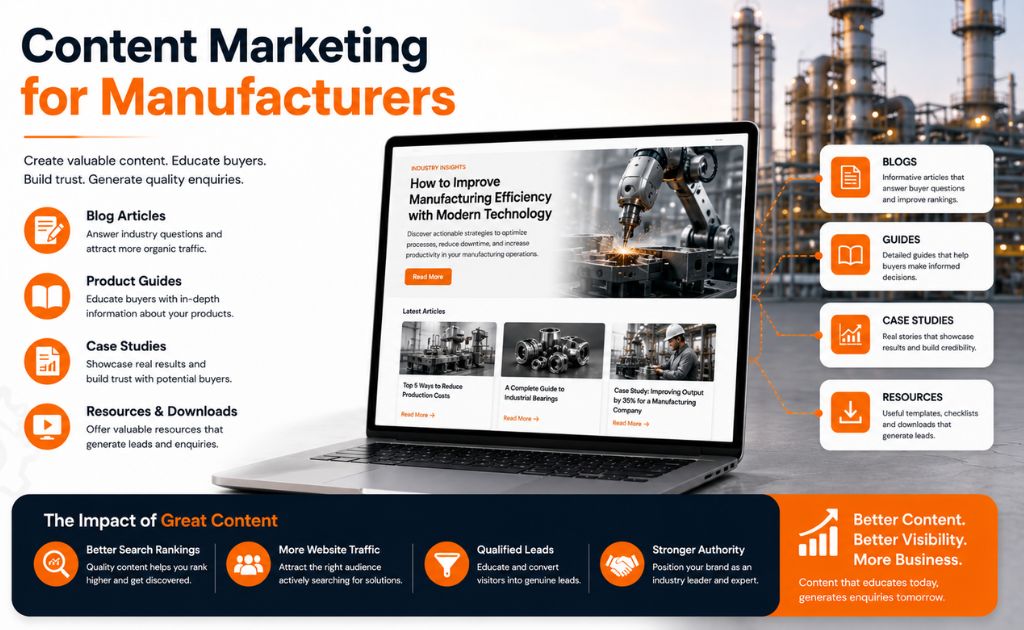
Showcase Products with Detailed Content
Product pages should go beyond basic specifications. Buyers appreciate detailed information that helps them evaluate whether your products meet their requirements.
Include:
- Product features
- Technical specifications
- Industry applications
- Material options
- Performance benefits
- Frequently asked questions
- Downloadable brochures
- Related products
Comprehensive product content improves both user experience and search performance.
Build Credibility with Case Studies
Case studies demonstrate how your products or services have solved real customer challenges. They provide practical examples of your expertise while helping potential buyers understand the value of your solutions.
An effective case study should include:
- Customer challenge
- Solution provided
- Implementation process
- Results achieved
- Client feedback (where available)
Case studies strengthen trust and support purchasing decisions.
Use Videos to Explain Complex Products
Manufacturing products often require detailed explanations. Videos make technical concepts easier to understand while increasing user engagement.
Examples include:
- Product demonstrations
- Factory tours
- Manufacturing process videos
- Installation guides
- Quality testing procedures
- Customer success stories
Video content can be embedded on product pages, blogs, and landing pages to improve the overall user experience.
Repurpose Content Across Multiple Channels
One piece of valuable content can be adapted into several formats to reach different audiences.
For example:
- Blog article → LinkedIn post
- Case study → Sales presentation
- Product guide → Downloadable PDF
- Factory video → Social media clips
- FAQ article → Email newsletter
Repurposing content increases its value while maintaining consistency across your marketing channels.
Content Marketing Ideas Table
| Content Type | Primary Goal | Best Used For |
|---|---|---|
| Blog Articles | Improve SEO | Educational searches |
| Product Guides | Support buying decisions | Product pages |
| Case Studies | Build trust | Sales enablement |
| Whitepapers | Demonstrate expertise | Lead generation |
| Videos | Increase engagement | Product demonstrations |
| FAQs | Answer buyer questions | SEO & AI Search |
| Downloadable Catalogues | Generate enquiries | Sales support |
CHAPTER 09
Google Ads for Manufacturers: Reach High-Intent Buyers Faster
While Search Engine Optimization (SEO) delivers sustainable long-term growth, Google Ads helps manufacturers generate immediate visibility by placing their business in front of potential customers who are actively searching for products and services. It is one of the fastest ways to attract qualified enquiries, launch new product campaigns, and compete for highly competitive manufacturing keywords.
Manufacturing buyers often search with clear purchasing intent using queries such as product names, industrial services, equipment specifications, or supplier locations. Google Ads enables your business to appear at the top of search results for these valuable searches, increasing the likelihood of attracting buyers who are ready to request a quotation or speak with your sales team.
When managed strategically, Google Ads complements your SEO efforts by driving targeted traffic, improving brand visibility, and generating measurable results through data-driven campaign optimization.
Why Google Ads Work for Manufacturing Companies
Unlike traditional advertising, Google Ads targets users based on their search intent. Your advertisements appear when potential buyers are actively looking for manufacturing products or industrial services, making it easier to connect with customers who are ready to make purchasing decisions.
For manufacturers, this means reaching engineers, procurement managers, contractors, distributors, and business owners at the exact moment they are searching for suppliers.
Search Campaigns
Search campaigns display text advertisements on Google Search when users enter relevant keywords. These campaigns are highly effective for manufacturers because they target customers with immediate purchase intent.
Examples include:
- Product-specific searches
- Manufacturing service keywords
- Location-based manufacturing searches
- OEM supplier searches
- Industrial equipment searches
Well-structured search campaigns help increase enquiries while maintaining better control over advertising budgets.
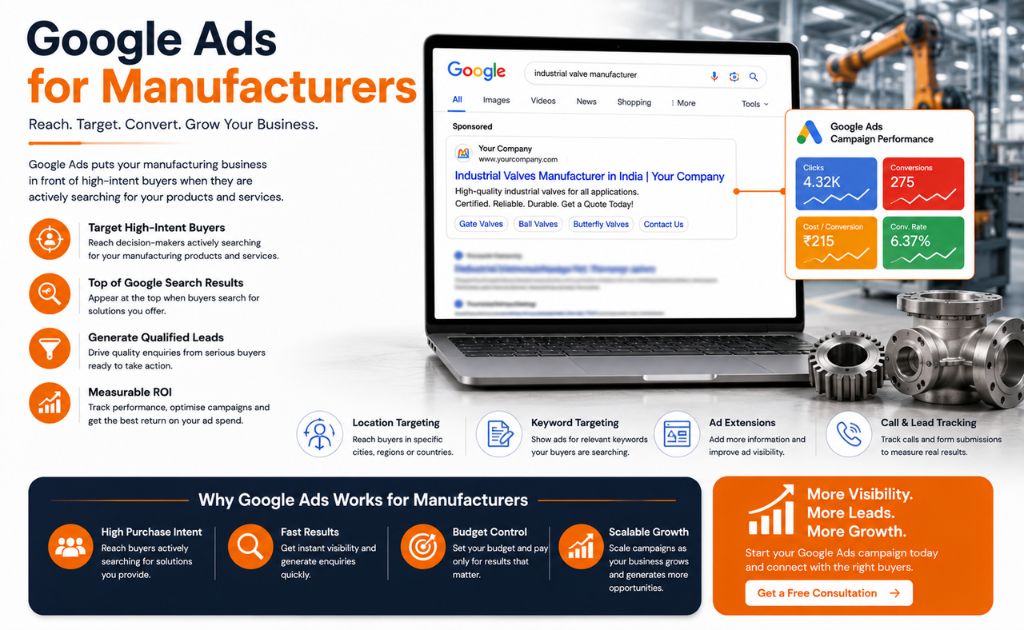
Performance Max Campaigns
Performance Max campaigns use Google’s AI to deliver advertisements across multiple platforms, including Search, Display, YouTube, Gmail, Discover, and Maps.
For manufacturers, these campaigns help increase brand visibility while reaching potential customers across different stages of the buying journey.
Remarketing Campaigns
Not every visitor contacts your business during their first website visit. Remarketing allows manufacturers to reconnect with previous visitors by displaying relevant advertisements while they continue browsing online.
Remarketing is particularly effective for:
- Product page visitors
- Catalogue downloads
- Quote request visitors
- Previous website enquiries
- Returning buyers
This helps keep your business visible until buyers are ready to take action.
Landing Page Optimization
Even the best advertising campaign will struggle without an effective landing page. Every Google Ads campaign should direct visitors to a dedicated page that matches the user’s search intent.
A high-converting manufacturing landing page should include:
- Clear product or service information
- Technical specifications
- Certifications
- Trust signals
- Strong call-to-action
- Simple enquiry form
- Contact details
A relevant landing page improves Quality Score, reduces advertising costs, and increases conversion rates.
Measuring Google Ads Performance
One of the biggest advantages of Google Ads is the ability to measure campaign performance accurately.
Manufacturers should monitor:
- Click-through Rate (CTR)
- Cost Per Click (CPC)
- Conversion Rate
- Cost Per Lead
- Quote Requests
- Return on Ad Spend (ROAS)
- Lead Quality
Regular campaign optimization ensures advertising budgets generate the highest possible return on investment.
Comparison Table
| Google Ads Campaign Type | Best For | Primary Goal |
|---|---|---|
| Search Campaigns | High-intent searches | Generate qualified enquiries |
| Performance Max | Multi-channel visibility | Increase reach and conversions |
| Display Campaigns | Brand awareness | Reach new audiences |
| Remarketing Campaigns | Returning visitors | Increase conversions |
| YouTube Ads | Product demonstrations | Build trust and awareness |
CHAPTER 10
LinkedIn Marketing for Manufacturers: Connect with Decision-Makers and Build Industry Authority
LinkedIn has become one of the most valuable digital marketing platforms for manufacturing companies looking to connect with business decision-makers. Unlike traditional social media platforms, LinkedIn is designed for professional networking, making it an ideal channel for reaching procurement managers, engineers, plant heads, operations managers, distributors, CEOs, and business owners who influence purchasing decisions.
Manufacturing buyers don’t use LinkedIn to make immediate purchases—they use it to discover industry trends, evaluate suppliers, follow trusted brands, and connect with professionals who demonstrate expertise. Maintaining an active LinkedIn presence helps manufacturers increase brand visibility, strengthen credibility, and stay top of mind throughout the buying journey.
When integrated with your website, SEO strategy, and content marketing efforts, LinkedIn becomes a powerful platform for generating awareness, nurturing relationships, and supporting long-term business growth.
Why LinkedIn Matters for Manufacturing Companies
Manufacturing businesses often operate in highly specialized industries where purchasing decisions involve multiple stakeholders. LinkedIn provides direct access to these professionals through company pages, industry groups, employee networks, and targeted advertising.
An active LinkedIn presence helps manufacturers:
- Build brand awareness
- Share industry expertise
- Connect with procurement professionals
- Generate qualified B2B enquiries
- Strengthen customer relationships
- Support recruitment and employer branding
Rather than focusing solely on promotional content, manufacturers should use LinkedIn to educate, inform, and engage their target audience.
Share Valuable Industry Content
Consistently publishing useful content positions your business as a trusted manufacturing partner. Instead of promoting products in every post, share content that helps your audience understand industry developments, solve technical challenges, and make informed purchasing decisions.
Examples include:
- Industry trends
- Product innovations
- Manufacturing process insights
- Factory updates
- Case studies
- Customer success stories
- Sustainability initiatives
- Behind-the-scenes production content
Educational posts typically generate higher engagement and encourage meaningful conversations with potential buyers.
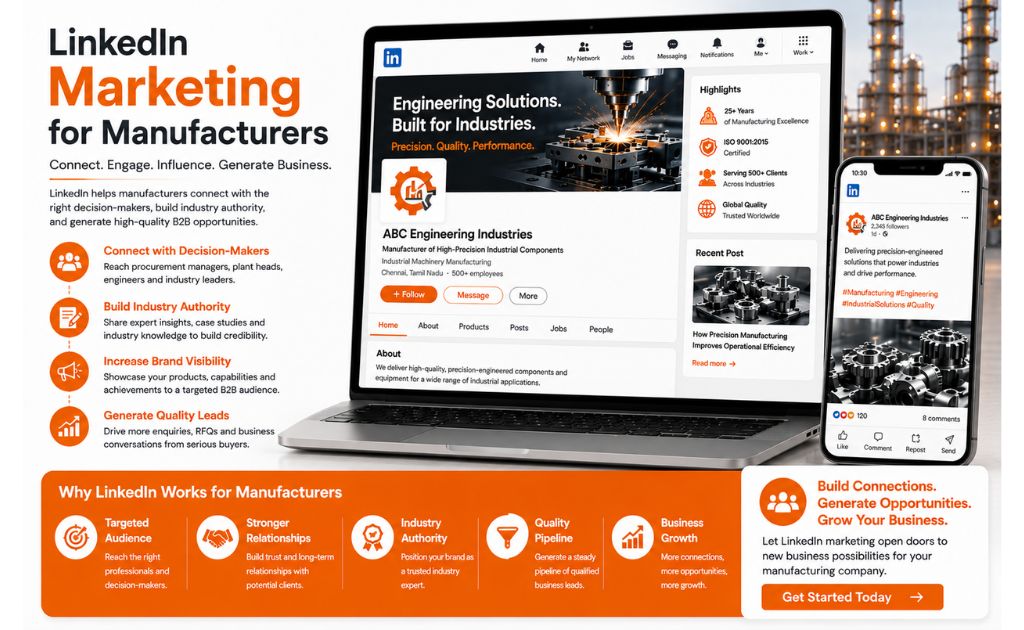
Build Trust Through Thought Leadership
Decision-makers prefer working with companies that demonstrate knowledge and experience. Sharing expert insights on LinkedIn allows manufacturers to establish thought leadership while increasing confidence among potential customers.
Consider publishing:
- Expert opinions
- Market insights
- Technical articles
- Industry event participation
- Product development updates
- Quality and compliance initiatives
Thought leadership creates long-term brand value while supporting your overall digital marketing strategy.
Encourage Employee Advocacy
Your employees can significantly expand the reach of your company’s content. Encouraging leadership, engineers, sales professionals, and technical experts to share company updates helps increase visibility and builds a more authentic brand presence.
Employee advocacy also strengthens trust because buyers often engage with people before engaging with businesses.
Use LinkedIn Advertising for Targeted B2B Campaigns
LinkedIn Ads allow manufacturers to reach specific audiences based on job title, industry, company size, seniority, and location. This makes it possible to promote high-value content, generate leads, or increase awareness among decision-makers who match your ideal customer profile.
Effective campaigns include:
- Lead generation campaigns
- Whitepaper promotions
- Webinar registrations
- Product launches
- Case study downloads
These campaigns work particularly well when paired with dedicated landing pages and compelling calls to action.
Measure LinkedIn Marketing Performance
Tracking performance helps manufacturers understand which content resonates with their audience and contributes to business growth.
Key metrics include:
- Post impressions
- Engagement rate
- Follower growth
- Website traffic from LinkedIn
- Lead generation
- Click-through rate (CTR)
- Conversion rate
Regular analysis allows you to refine your content strategy and improve campaign effectiveness over time.
Comparison Table
| LinkedIn Activity | Business Benefit |
|---|---|
| Educational Posts | Build industry authority |
| Case Studies | Increase buyer confidence |
| Product Updates | Showcase innovation |
| Employee Advocacy | Expand brand reach |
| LinkedIn Ads | Generate targeted B2B leads |
| Thought Leadership | Strengthen trust and credibility |
CHAPTER 11
Email Marketing for Manufacturers: Nurture Leads and Build Long-Term Customer Relationships
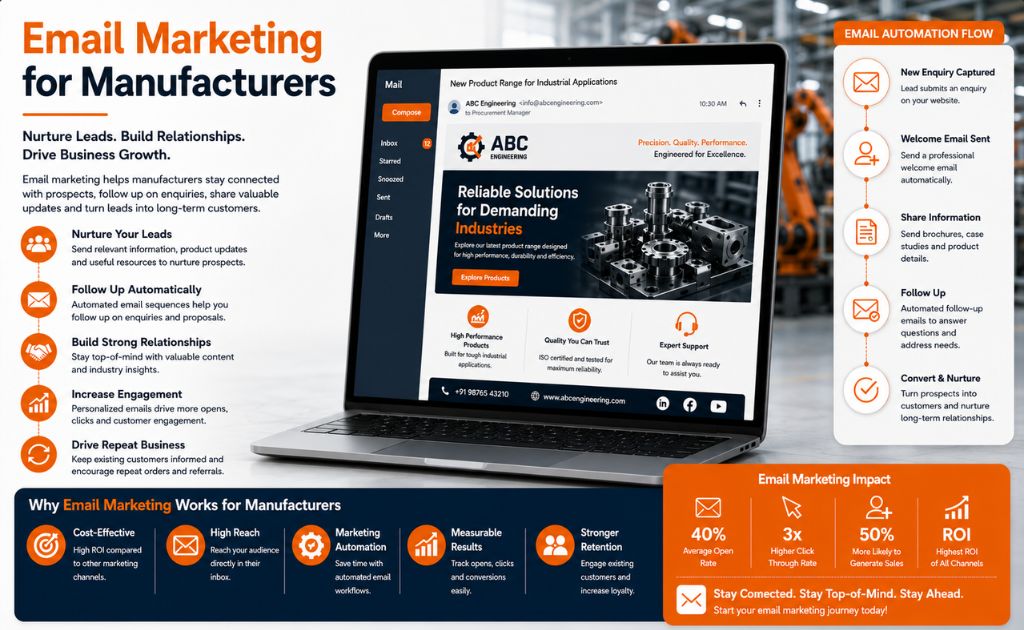
Email marketing remains one of the most cost-effective digital marketing channels for manufacturers. While SEO, Google Ads, and LinkedIn help attract potential customers, email marketing keeps your business connected with prospects throughout the buying journey and strengthens relationships with existing customers.
Manufacturing purchases rarely happen after a single website visit. Buyers often spend weeks or months evaluating suppliers, comparing technical specifications, discussing requirements with stakeholders, and reviewing quotations before making a final decision. A well-planned email marketing strategy keeps your business visible during this process by delivering valuable information, product updates, technical resources, and timely follow-ups.
Beyond lead nurturing, email marketing also helps manufacturers improve customer retention, encourage repeat business, promote new products, and maintain long-term communication with distributors, partners, and industrial clients.
Nurture Leads Throughout the Buying Journey
Not every prospect is ready to make an immediate purchasing decision. Many visitors download a catalogue, request product information, or browse your website before contacting your sales team.
Email nurturing allows manufacturers to maintain communication by sharing relevant information that helps prospects move closer to making a purchasing decision.
Examples include:
- Product brochures
- Industry insights
- Technical resources
- Product comparison guides
- Case studies
- Customer success stories
Providing valuable information keeps your business top of mind while building trust over time.
Automate Follow-Up Communications
Marketing automation allows manufacturers to send timely and personalized emails based on customer actions.
For example:
- Welcome emails after an enquiry
- Catalogue download follow-ups
- Quote reminders
- Product recommendation emails
- Appointment confirmations
- Thank-you emails
Automation reduces manual effort while ensuring every prospect receives consistent communication.
Share Product Updates and Industry News
Regular newsletters keep customers informed about new product launches, manufacturing capabilities, certifications, company milestones, and industry developments.
Useful newsletter content includes:
- New product announcements
- Production capacity updates
- Industry trends
- Trade show participation
- Quality certifications
- Manufacturing innovations
Relevant and informative emails encourage customers to remain engaged with your brand.
Strengthen Customer Retention
Maintaining relationships with existing customers is just as important as generating new enquiries. Email marketing helps manufacturers continue delivering value after the initial sale through product updates, maintenance tips, technical documentation, and customer support resources.
Consistent communication increases customer satisfaction while creating opportunities for repeat orders and long-term partnerships.
Personalize Email Campaigns
Different customers have different requirements. Segmenting your email database allows manufacturers to deliver more relevant content based on industry, product interest, purchase history, or customer lifecycle stage.
Examples include:
- Prospective customers
- Existing customers
- Distributors
- OEM partners
- Export clients
- Industry-specific segments
Personalized emails generally achieve higher engagement and conversion rates than generic campaigns.
Measure Email Marketing Performance
Tracking campaign performance helps manufacturers continuously improve their email strategy.
Important metrics include:
- Open Rate
- Click-Through Rate (CTR)
- Conversion Rate
- Unsubscribe Rate
- Enquiry Generation
- Quote Requests
- Customer Retention Rate
Monitoring these metrics ensures your campaigns continue delivering measurable business value.
Comparison Table
| Email Campaign Type | Primary Objective | Business Benefit |
|---|---|---|
| Welcome Emails | Introduce your business | Build first impressions |
| Lead Nurturing | Educate prospects | Increase conversions |
| Product Updates | Promote new solutions | Improve customer engagement |
| Newsletters | Share valuable insights | Strengthen relationships |
| Follow-Up Emails | Encourage enquiries | Generate qualified leads |
| Customer Retention Emails | Maintain communication | Increase repeat business |
CHAPTER 12
Video Marketing for Manufacturers: Showcase Your Expertise and Build Buyer Confidence
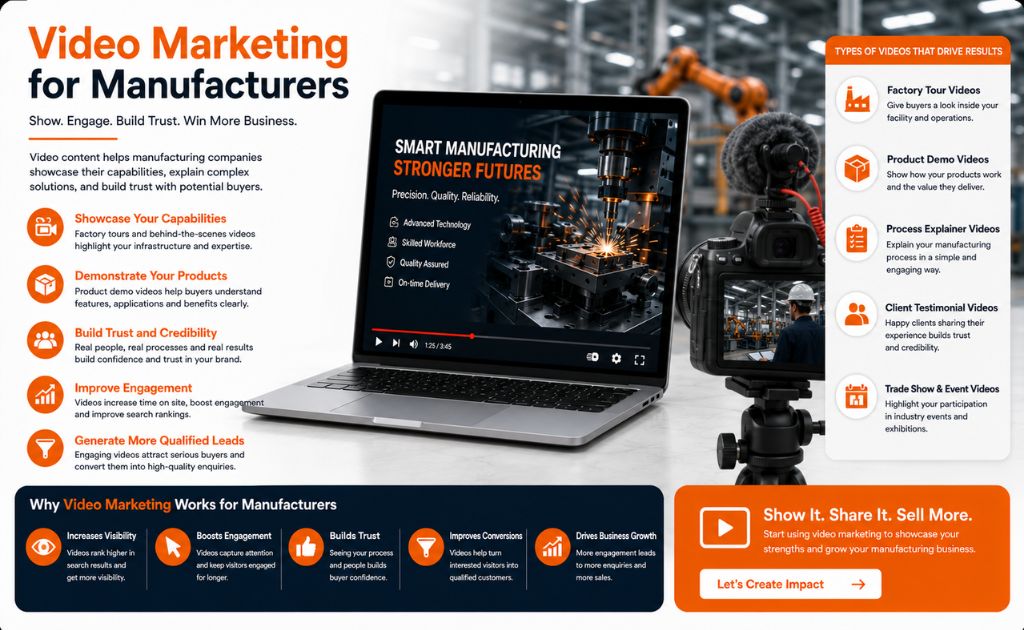
Video marketing has become one of the most engaging ways for manufacturers to communicate their capabilities, demonstrate product quality, and build trust with potential customers. Instead of relying solely on text and images, videos allow buyers to see your manufacturing processes, understand product applications, and gain confidence in your expertise before making an enquiry.
Manufacturing buyers often evaluate multiple suppliers before making purchasing decisions. Product demonstrations, factory walkthroughs, quality control procedures, and customer success stories provide valuable insights that help differentiate your business from competitors. Videos also increase engagement across your website, social media platforms, email campaigns, and search results, making them an essential part of a modern digital marketing strategy.
When combined with SEO and content marketing, video content improves user experience, supports lead generation, and helps manufacturers communicate complex technical information in a clear and engaging format.
Showcase Your Manufacturing Facility
A factory tour gives potential customers an inside look at your production environment, equipment, workforce, and quality standards. It helps buyers understand your manufacturing capabilities while building confidence in your operations.
A factory tour video can highlight:
- Production facilities
- Advanced machinery
- Manufacturing processes
- Quality control procedures
- Safety standards
- Warehouse and logistics
- Team expertise
Factory videos provide transparency and reinforce your company’s professionalism.
Create Product Demonstration Videos
Product demonstration videos help buyers understand how your products work, their key features, technical specifications, and practical applications.
Manufacturers can create videos that demonstrate:
- Product functionality
- Installation process
- Product performance
- Technical specifications
- Product comparisons
- Maintenance procedures
These videos answer common customer questions while reducing uncertainty during the buying process.
Explain Complex Manufacturing Processes
Many manufacturing products and services involve technical processes that are easier to understand through visual demonstrations.
Educational videos can explain:
- Manufacturing workflow
- Production technology
- Material selection
- Quality assurance
- Packaging process
- Custom manufacturing capabilities
Visual explanations improve buyer understanding while positioning your business as an industry expert.
Build Trust with Customer Testimonials
Customer testimonial videos provide social proof by allowing existing clients to share their experience working with your business.
Testimonials can highlight:
- Product quality
- Project outcomes
- Customer service
- Delivery performance
- Long-term partnerships
- Business results
Authentic customer stories increase credibility and help potential buyers feel more confident about choosing your company.
Optimize Videos for Search Engines
Publishing videos is only part of the strategy. Proper optimization helps improve visibility across Google, YouTube, and your website.
Best practices include:
- Keyword-rich video titles
- Informative descriptions
- Custom thumbnails
- Closed captions
- Video transcripts
- Structured data
- Optimized file names
Embedding videos on relevant product and service pages also increases user engagement and supports SEO.
Distribute Videos Across Multiple Platforms
To maximize reach, manufacturers should publish videos across multiple digital channels.
Recommended platforms include:
- Company website
- YouTube
- Email campaigns
- Google Business Profile
Repurposing one video into shorter clips allows you to reach different audiences while maintaining consistent brand messaging.
Comparison Table
| Video Type | Primary Objective | Best Platform |
|---|---|---|
| Factory Tour | Build trust | Website & YouTube |
| Product Demonstration | Explain products | Website & YouTube |
| Customer Testimonial | Increase credibility | Website & LinkedIn |
| Manufacturing Process | Educate buyers | Website & YouTube |
| Company Introduction | Brand awareness | Website & Social Media |
| Installation Guide | Customer support | YouTube & Knowledge Base |
CHAPTER 13
AI Search Optimization for Manufacturers: Prepare Your Business for the Future of Search
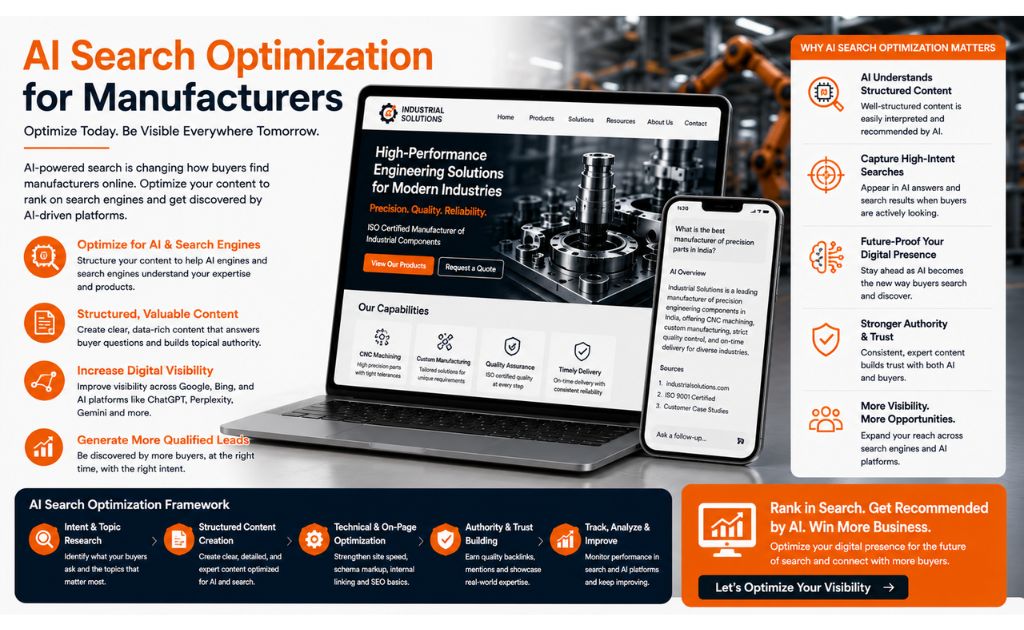
Search is evolving rapidly. Alongside traditional search results, buyers now use AI-powered platforms to research suppliers, compare products, understand technical concepts, and discover manufacturing companies. Instead of reviewing multiple websites individually, many decision-makers ask AI assistants for recommendations, product comparisons, and industry insights before visiting a supplier’s website.
For manufacturers, this shift means digital marketing strategies must go beyond traditional SEO. Businesses need well-structured, trustworthy, and comprehensive content that AI-powered search platforms can easily understand and reference. Companies that invest in high-quality content, technical optimization, and clear information architecture are better positioned to improve visibility across both search engines and AI-assisted search experiences.
AI Search Optimization complements your existing SEO strategy by making your website easier for search engines and AI systems to interpret, increasing the likelihood that your content is surfaced when buyers research manufacturing products and services.
Create Helpful, In-Depth Content
AI-powered search systems prioritize content that provides clear, accurate, and comprehensive answers to user questions. Manufacturers should focus on publishing detailed resources that address real customer needs rather than creating thin or repetitive pages.
High-value content includes:
- Product guides
- Industry resources
- Technical documentation
- Buying guides
- Comparison articles
- Case studies
- Frequently Asked Questions
Comprehensive content demonstrates expertise while improving visibility across traditional and AI-powered search experiences.
Organize Content with Clear Heading Structure
Well-organized content is easier for both readers and AI systems to understand. Using descriptive headings, logical page hierarchy, and structured formatting improves readability while helping search engines identify the relationship between topics.
Best practices include:
- One H1 per page
- Descriptive H2 and H3 headings
- Short paragraphs
- Bullet lists
- Comparison tables
- FAQ sections
- Internal links between related topics
A clear structure allows buyers to quickly find information while improving content accessibility.
Build Topical Authority
Manufacturers that consistently publish high-quality content around their products, services, and industries are more likely to be recognized as authoritative sources.
Develop content around related topics such as:
- Manufacturing processes
- Product applications
- Industry regulations
- Material selection
- Quality standards
- Technical specifications
- Maintenance guides
- Industry trends
Covering a topic comprehensively helps search engines understand your expertise and improves overall search visibility.
Use Structured Data and Technical SEO
Structured data provides additional context about your website, products, services, and business information. Combined with strong technical SEO, it helps search engines better understand your content.
Recommended structured data includes:
- Organization
- Article
- FAQ
- Breadcrumb
- Product
- Local Business
- Image Object
A technically optimized website with accurate structured data improves discoverability and enhances the presentation of your content in search results.
Demonstrate Experience and Expertise
Manufacturing buyers value practical experience and technical knowledge. Your website should clearly demonstrate your expertise by showcasing:
- Industry experience
- Certifications
- Manufacturing capabilities
- Customer success stories
- Product expertise
- Quality assurance processes
- Original insights
Providing evidence of real-world experience strengthens trust with both buyers and search systems.
Keep Content Updated
Manufacturing technologies, standards, regulations, and customer expectations continue to evolve. Regularly reviewing and updating your content ensures it remains accurate, relevant, and valuable.
Updating existing pages with new insights, statistics, product information, and industry developments helps maintain long-term search visibility while improving the user experience.
Comparison Table
| Traditional SEO | AI Search Optimization |
|---|---|
| Focuses on keyword relevance | Focuses on comprehensive topic coverage |
| Optimizes individual pages | Builds topical authority across related content |
| Improves search rankings | Improves visibility across AI-assisted search experiences |
| Targets search intent | Answers complex user questions clearly |
| Uses structured metadata | Combines structured data with contextual expertise |
CHAPTER 14
How Manufacturers Can Generate More Qualified Leads with Digital Marketing
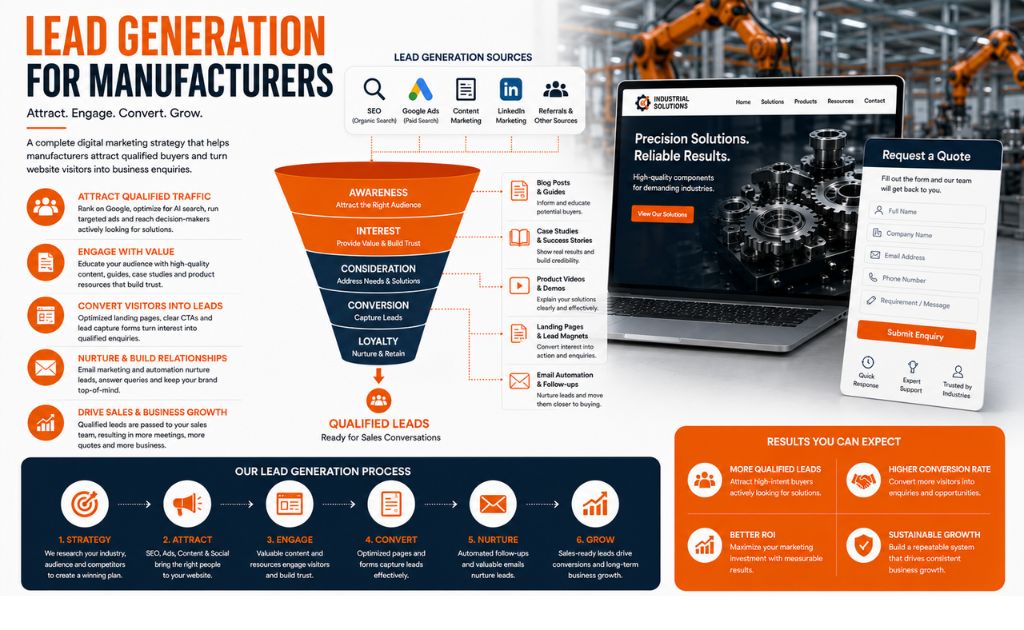
Generating website traffic is only one part of a successful digital marketing strategy. The real objective is attracting qualified prospects who are actively looking for your products or services and converting them into valuable business enquiries. For manufacturers, quality always matters more than quantity. A smaller number of highly relevant enquiries often delivers better business outcomes than thousands of untargeted website visitors.
Qualified leads typically come from buyers who have already identified a requirement, researched potential suppliers, and are ready to discuss specifications, pricing, or production capabilities. By combining SEO, content marketing, paid advertising, website optimization, and lead nurturing, manufacturers can create a predictable system for generating high-quality enquiries throughout the year.
A structured lead generation strategy ensures every stage of the buyer journey is supported—from the first Google search to the final quotation request and beyond.
Attract High-Intent Buyers Through Search
The most valuable manufacturing leads often begin with a search engine. Buyers looking for industrial products, manufacturing services, or OEM partners usually search using specific keywords that indicate strong purchasing intent.
Manufacturers can improve visibility by targeting:
- Product-specific keywords
- Industry-specific searches
- Application-based keywords
- Location-based searches
- Technical solution queries
Ranking for these searches attracts visitors who are already interested in your products or services.
Create High-Converting Landing Pages
Every marketing campaign should direct visitors to a dedicated landing page that matches their search intent.
A high-performing manufacturing landing page should include:
- Clear product or service information
- Technical specifications
- Industry applications
- Certifications and trust signals
- Customer testimonials
- Strong call-to-action
- Simple enquiry form
- Contact details
Reducing distractions and focusing on a single objective improves conversion rates.
Offer Valuable Resources
Providing useful resources encourages potential customers to share their contact information while demonstrating your expertise.
Examples include:
- Product catalogues
- Technical datasheets
- Buying guides
- Industry reports
- Manufacturing checklists
- Product comparison sheets
- Consultation requests
These resources help manufacturers generate qualified leads while supporting the buyer’s research process.
Optimize Every Call-to-Action
Every important page should clearly guide visitors toward the next step.
Examples include:
- Request a Quote
- Schedule a Consultation
- Download Product Catalogue
- Contact Our Sales Team
- Speak with an Expert
Effective calls-to-action are clear, visible, and relevant to the page content.
Build Trust Before Asking for an Enquiry
Buyers are more likely to contact manufacturers they trust.
Trust can be established through:
- Industry certifications
- Customer testimonials
- Case studies
- Manufacturing facility images
- Years of experience
- Client logos
- Quality assurance processes
- Awards and recognitions
Displaying these trust signals throughout your website reduces hesitation and increases enquiry rates.
Measure and Improve Lead Quality
Generating leads is only the beginning. Manufacturers should continuously evaluate lead quality to understand which marketing channels deliver the best business outcomes.
Track metrics such as:
- Qualified enquiries
- Quote requests
- Conversion rate
- Cost per lead
- Sales opportunities
- Customer acquisition cost
- Revenue generated
Regular analysis helps optimize campaigns and improve marketing performance over time.
Comparison Table
| Lead Generation Strategy | Business Benefit |
|---|---|
| SEO | Attract high-intent buyers |
| Landing Pages | Increase enquiry conversions |
| Content Marketing | Build trust and educate buyers |
| Google Ads | Generate immediate enquiries |
| Email Marketing | Nurture prospects |
| CRO | Improve website conversion rates |
| CRM Integration | Manage and track leads effectively |
CHAPTER 15
Measuring Digital Marketing Success: KPIs Every Manufacturer Should Track
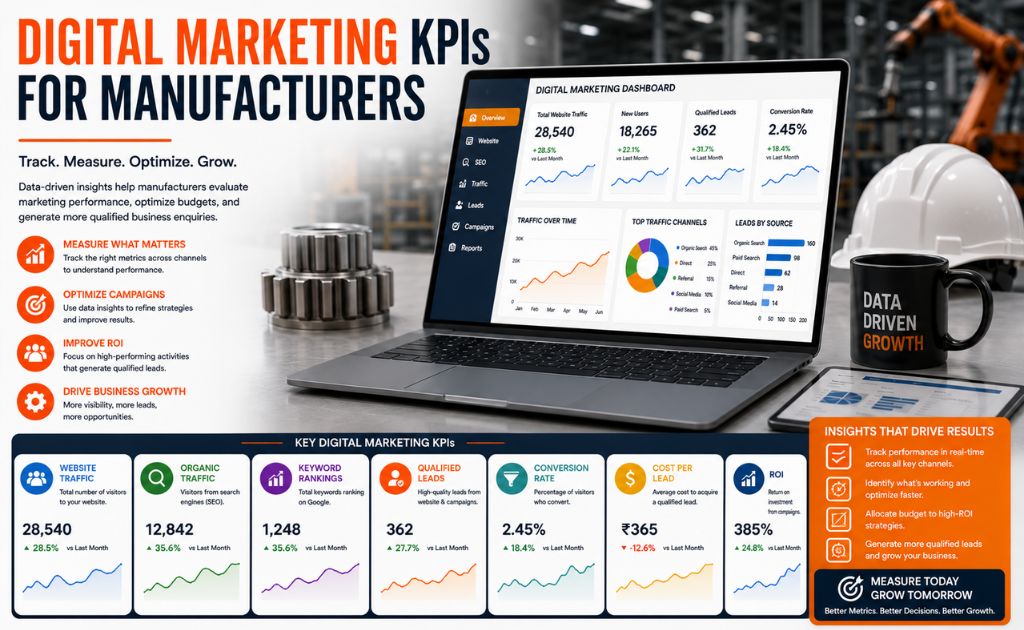
Investing in digital marketing is only valuable when you can measure its impact on your business. For manufacturers, success goes beyond increasing website traffic or social media engagement. The real objective is to attract qualified buyers, generate enquiries, improve conversion rates, and increase revenue.
Tracking the right Key Performance Indicators (KPIs) helps manufacturers understand which marketing strategies are working, where improvements are needed, and how marketing contributes to long-term business growth. By regularly reviewing performance data, businesses can make informed decisions, optimise campaigns, and allocate budgets more effectively.
Whether your focus is SEO, Google Ads, content marketing, LinkedIn, or email marketing, monitoring the right metrics ensures every marketing activity supports your business objectives.
Organic Website Traffic
Organic traffic measures the number of visitors who discover your website through search engines without clicking on paid advertisements.
Steady growth in organic traffic indicates that your SEO strategy is improving visibility for relevant manufacturing keywords. However, traffic should always be evaluated alongside lead quality to ensure you’re attracting the right audience.
A consistent increase in qualified organic traffic often reflects stronger search rankings, improved topical authority, and greater brand visibility.
Keyword Rankings
Keyword rankings show where your website appears in search results for important manufacturing-related search terms.
Rather than monitoring hundreds of keywords, focus on the search terms most likely to generate qualified enquiries, including:
- Product keywords
- Service keywords
- Industry-specific keywords
- Location-based keywords
- Commercial-intent keywords
Higher rankings for relevant keywords increase the likelihood of attracting buyers who are actively searching for manufacturing solutions.
Qualified Lead Generation
Generating enquiries is important, but generating the right enquiries is even more valuable.
Track metrics such as:
- Quote requests
- Contact form submissions
- Phone enquiries
- Catalogue downloads
- Consultation requests
Evaluating lead quality helps identify which marketing channels attract customers with genuine purchasing intent.
Website Conversion Rate
Conversion rate measures how effectively your website turns visitors into leads.
Improving website speed, user experience, landing pages, enquiry forms, and calls-to-action can significantly increase conversions without increasing traffic.
Even a small improvement in conversion rate can result in more qualified business opportunities from existing website visitors.
Customer Acquisition Cost (CAC)
Customer Acquisition Cost measures the average investment required to acquire a new customer.
Understanding this metric helps manufacturers compare marketing channels, optimise advertising budgets, and improve return on investment.
Lower acquisition costs combined with higher-quality customers indicate a more efficient marketing strategy.
Return on Marketing Investment (ROMI)
Return on Marketing Investment evaluates how effectively marketing activities contribute to business growth.
Instead of measuring clicks or impressions alone, manufacturers should assess how digital marketing contributes to:
- Revenue growth
- Sales opportunities
- Customer acquisition
- Customer retention
- Business profitability
Tracking marketing performance from enquiry to closed sale provides a clearer understanding of long-term success.
KPI Tracking Table
| KPI | Why It Matters | Business Goal |
|---|---|---|
| Organic Traffic | Measures search visibility | Increase qualified website visitors |
| Keyword Rankings | Tracks SEO performance | Improve Google visibility |
| Qualified Leads | Measures enquiry quality | Generate more sales opportunities |
| Conversion Rate | Evaluates website performance | Convert more visitors into enquiries |
| Customer Acquisition Cost | Measures marketing efficiency | Reduce acquisition costs |
| Return on Marketing Investment | Measures business impact | Increase profitability |
| Bounce Rate | Indicates user engagement | Improve user experience |
| Average Session Duration | Shows content engagement | Increase visitor interaction |
CHAPTER 16
Digital Marketing Budget for Manufacturers: How Much Should You Invest?
One of the first questions manufacturing companies ask before implementing a digital marketing strategy is how much they should invest. The answer depends on several factors, including your business size, target market, competition, growth objectives, and the digital channels you plan to use.
Rather than viewing digital marketing as a business expense, manufacturers should consider it a long-term investment that generates qualified leads, strengthens brand visibility, and supports sustainable revenue growth. A well-planned budget ensures your marketing efforts remain consistent while delivering measurable returns over time.
Instead of investing heavily in a single channel, successful manufacturers distribute their budget across multiple digital marketing activities that work together to support the entire customer journey.
Factors That Influence Your Marketing Budget
Every manufacturing business has different marketing requirements. A company targeting local industrial clients will have different priorities than a manufacturer exporting products globally.
When planning your digital marketing budget, consider:
- Business size
- Industry competition
- Target locations
- Number of products or services
- Website performance
- Sales goals
- Existing brand visibility
- Marketing objectives
These factors help determine where your budget will deliver the greatest impact.
Allocate Your Budget Across Multiple Channels
A balanced marketing strategy generally delivers better long-term results than focusing on a single platform.
Your investment may include:
- Website optimization
- Search Engine Optimization (SEO)
- Content marketing
- Google Ads
- LinkedIn marketing
- Email marketing
- Video marketing
- Analytics and reporting
Each channel contributes differently depending on your business goals and stage of growth.
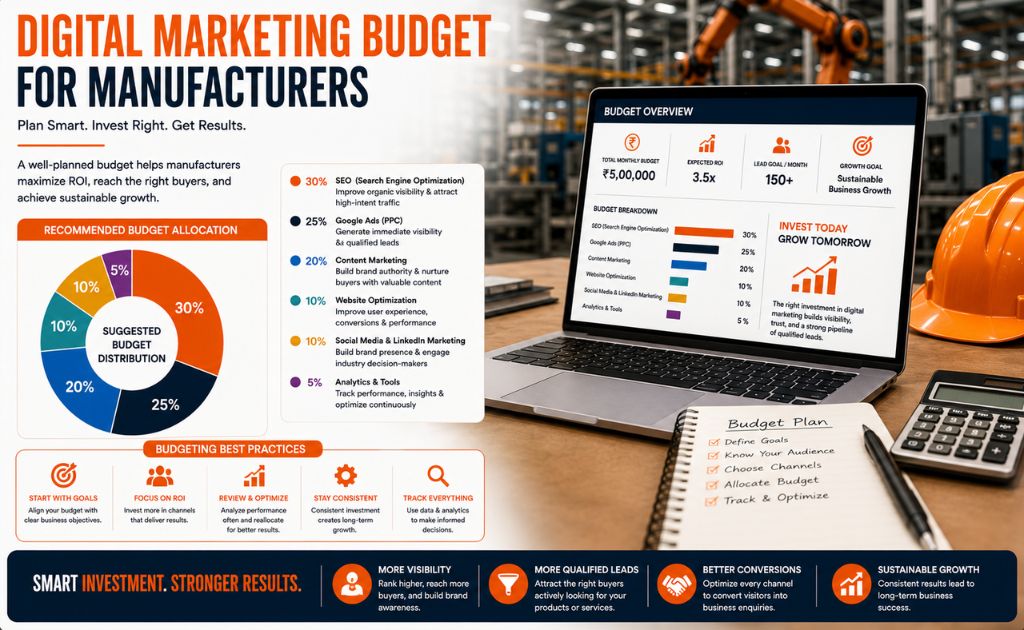
Budget Allocation by Business Goal
Different marketing objectives require different investment priorities.
| Business Goal | Recommended Focus |
|---|---|
| Improve Google Rankings | SEO and Content Marketing |
| Generate Immediate Leads | Google Ads and Landing Pages |
| Increase Brand Awareness | LinkedIn and Video Marketing |
| Improve Website Performance | Website Optimization and CRO |
| Build Customer Relationships | Email Marketing and CRM |
Aligning your budget with business objectives ensures every marketing activity supports measurable outcomes.
Focus on Long-Term Return on Investment
Digital marketing delivers the best results when viewed as a continuous growth strategy rather than a short-term campaign.
For example:
- SEO builds long-term organic visibility.
- Content marketing strengthens authority over time.
- Google Ads generates immediate enquiries.
- Email marketing improves customer retention.
- Conversion optimization increases the value of existing traffic.
Combining these channels creates a sustainable marketing system that continues generating opportunities as your business grows.
Review and Adjust Your Budget Regularly
Marketing performance should be reviewed consistently to ensure your investment continues producing results.
Regular reviews help manufacturers:
- Identify high-performing channels
- Reduce spending on underperforming campaigns
- Improve lead quality
- Increase return on investment
- Respond to changing market conditions
Data-driven decisions ensure your marketing budget remains aligned with business growth objectives.
Budget Allocation Example
| Marketing Activity | Primary Objective |
|---|---|
| Website Optimization | Improve user experience |
| SEO | Increase organic visibility |
| Content Marketing | Build authority and attract buyers |
| Google Ads | Generate immediate enquiries |
| LinkedIn Marketing | Connect with B2B decision-makers |
| Email Marketing | Nurture leads and retain customers |
| Video Marketing | Build trust and showcase expertise |
| Analytics | Measure performance and optimise campaigns |
CHAPTER 17
Common Digital Marketing Mistakes Manufacturers Should Avoid
Even manufacturers with excellent products and years of industry experience can struggle to generate consistent online enquiries if their digital marketing strategy isn’t aligned with modern buyer behaviour. Many businesses invest in websites, advertising, or social media but fail to achieve meaningful results because of avoidable mistakes.
Successful digital marketing is not about using every available channel. It’s about implementing the right strategies, measuring performance, and continuously improving based on data and customer behaviour. By recognising the most common mistakes, manufacturers can strengthen their online presence, improve lead quality, and maximise the return on their marketing investment.
Below are some of the most common digital marketing mistakes manufacturing companies make—and how to avoid them.
Relying Only on Referrals and Traditional Marketing
Referrals, trade shows, and long-standing customer relationships remain valuable, but relying on them as the only source of new business limits growth opportunities.
Digital marketing helps manufacturers create a consistent pipeline of qualified enquiries by reaching buyers who are actively searching online for products and services. Combining traditional marketing with SEO, content marketing, and paid advertising creates a more balanced and sustainable lead generation strategy.
Ignoring Search Engine Optimization (SEO)
Many manufacturers launch a website but never optimise it for search engines. Without SEO, even the best-designed website may struggle to attract relevant visitors.
Common SEO issues include:
- Missing keyword optimization
- Poor website structure
- Slow loading pages
- Duplicate content
- Missing metadata
- Weak internal linking
A strong SEO strategy helps manufacturers improve visibility, attract qualified buyers, and generate long-term organic traffic.
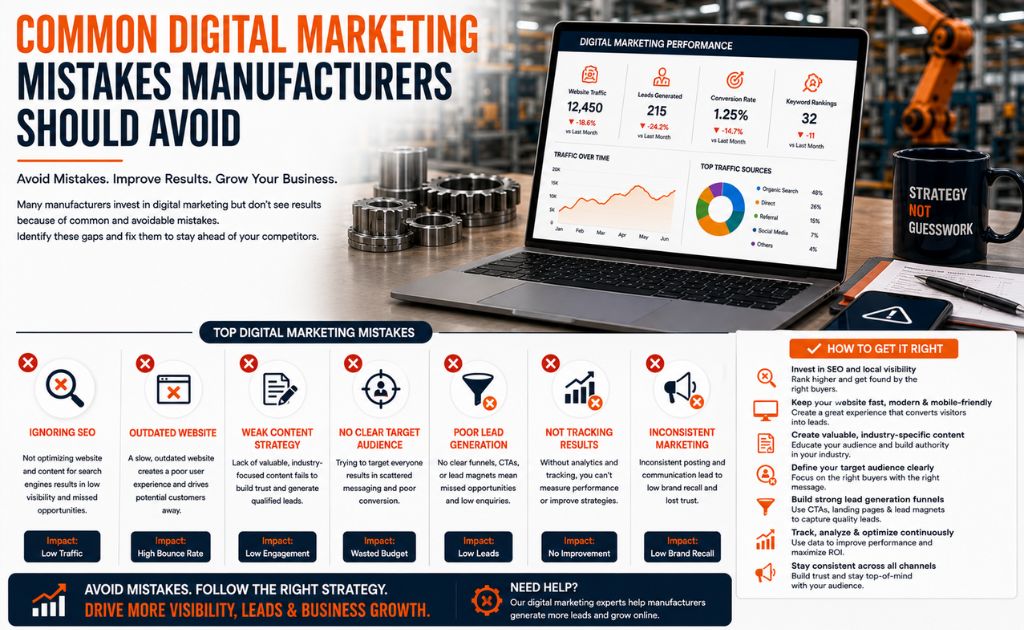
Treating Your Website as an Online Brochure
A website should be more than a place to display company information. It should educate buyers, demonstrate expertise, showcase products, and encourage enquiries.
Manufacturers should regularly update their websites with:
- New product pages
- Industry content
- Case studies
- Customer testimonials
- Technical resources
- Clear calls-to-action
A dynamic website supports both SEO and lead generation.
Publishing Inconsistent or Low-Quality Content
Publishing content only occasionally or focusing on promotional messaging limits long-term growth.
Successful manufacturers consistently publish educational, relevant, and well-structured content that addresses buyer questions and demonstrates industry expertise.
Consistency builds topical authority while improving visibility for a wider range of search queries.
Ignoring Website Analytics
Without measuring performance, it’s difficult to know which marketing activities generate qualified leads.
Manufacturers should regularly monitor:
- Website traffic
- Organic search performance
- Conversion rates
- Enquiry sources
- Landing page performance
- Return on investment
Using analytics allows businesses to identify opportunities for improvement and make informed marketing decisions.
Failing to Build Trust
Industrial buyers often compare several suppliers before making a decision. If your website lacks trust signals, potential customers may move on to competitors.
Strengthen credibility by including:
- Certifications
- Client testimonials
- Case studies
- Manufacturing capabilities
- Factory images
- Awards
- Years of experience
- Quality assurance processes
Trust-building content plays a significant role in increasing enquiry rates.
Mistakes vs Best Practices Table
| Common Mistake | Best Practice |
|---|---|
| Depending only on referrals | Build a multi-channel digital marketing strategy |
| Ignoring SEO | Optimise every important website page |
| Outdated website | Regularly improve user experience and content |
| Weak content strategy | Publish educational industry content consistently |
| No performance tracking | Monitor KPIs and optimise campaigns |
| Limited trust signals | Showcase certifications, case studies, and testimonials |
| Poor calls-to-action | Use clear, action-oriented enquiry buttons |
CHAPTER 18
Manufacturing Digital Marketing Checklist
A successful digital marketing strategy isn’t built overnight. It requires a combination of technical optimization, high-quality content, effective lead generation, and continuous performance improvement. Whether you’re just beginning your digital transformation or refining an existing strategy, this checklist can help ensure your manufacturing business is following the essential practices needed to improve online visibility, attract qualified buyers, and generate consistent business enquiries.
Use this checklist to review your current marketing efforts, identify opportunities for improvement, and create a stronger foundation for long-term growth.
Website Optimization Checklist
Before investing in SEO or paid advertising, ensure your website is technically sound and provides an excellent user experience.
☐ Mobile-friendly website
☐ Fast page loading speed
☐ Secure HTTPS website
☐ Clear navigation structure
☐ Dedicated product and service pages
☐ Easy-to-use enquiry forms
☐ Strong call-to-action buttons
☐ Updated contact information
☐ Customer testimonials
☐ Industry certifications displayed
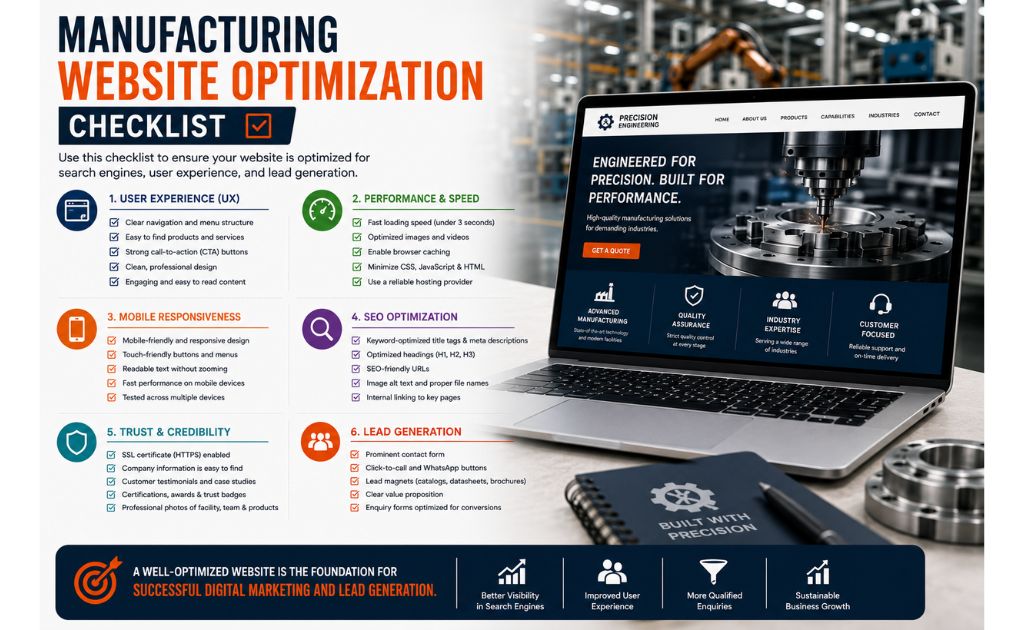
SEO Checklist
Improve your visibility in search engines with these essential SEO practices.
☐ Keyword research completed
☐ Optimized page titles and meta descriptions
☐ Proper heading hierarchy (H1, H2, H3)
☐ Internal linking implemented
☐ Optimized product pages
☐ Image file names and alt text optimized
☐ XML sitemap submitted
☐ Schema markup implemented
☐ Core Web Vitals optimized
☐ Google Search Console configured
Content Marketing Checklist
Maintain a consistent publishing strategy that supports both SEO and buyer education.
☐ Publish industry blogs regularly
☐ Create buying guides
☐ Develop case studies
☐ Update product pages
☐ Answer frequently asked questions
☐ Produce educational videos
☐ Repurpose content across platforms
☐ Keep content updated
Lead Generation Checklist
Make it easy for visitors to become qualified enquiries.
☐ Clear enquiry forms
☐ Request a Quote button
☐ Downloadable product catalogue
☐ Contact details visible
☐ Landing pages optimized
☐ Trust signals included
☐ CRM integration
☐ Lead tracking enabled
Performance Measurement Checklist
Regularly review marketing performance to improve results.
☐ Track organic traffic
☐ Monitor keyword rankings
☐ Measure conversion rate
☐ Review Google Ads performance
☐ Analyse lead quality
☐ Track customer acquisition cost
☐ Monitor ROI
☐ Review website performance monthly
Manufacturing Digital Marketing Success Checklist
| Marketing Area | Status |
|---|---|
| Website Optimization | ☐ Complete |
| Search Engine Optimization | ☐ Complete |
| Content Marketing | ☐ Complete |
| Google Ads | ☐ Complete |
| LinkedIn Marketing | ☐ Complete |
| Email Marketing | ☐ Complete |
| Video Marketing | ☐ Complete |
| AI Search Optimization | ☐ Complete |
| Lead Generation | ☐ Complete |
| Analytics & Reporting | ☐ Complete |
CHAPTER 19
Frequently Asked Questions About Digital Marketing for Manufacturers
Manufacturers often have questions about how digital marketing works, which strategies deliver the best results, and how to measure success. The answers below address some of the most common questions businesses ask before investing in digital marketing.
What is digital marketing for manufacturers?
Digital marketing for manufacturers is the use of online channels such as search engine optimization (SEO), content marketing, Google Ads, LinkedIn marketing, email marketing, and website optimization to promote manufacturing products and services. It helps manufacturing companies increase online visibility, attract qualified buyers, generate business enquiries, and build long-term customer relationships.
Why is digital marketing important for manufacturing companies?
Today’s manufacturing buyers research suppliers online before requesting a quotation or contacting a sales team. A strong digital marketing strategy helps manufacturers appear in search results, demonstrate expertise, build trust, and connect with decision-makers throughout the buying journey. This results in higher-quality leads and sustainable business growth.
How long does it take to see results from digital marketing for manufacturers?
The timeline depends on the marketing strategy being used. Google Ads can begin generating enquiries shortly after campaigns launch, while SEO and content marketing typically deliver stronger long-term results over several months. Manufacturers who consistently invest in website optimization, valuable content, and search visibility generally achieve the best long-term return on investment.
How can SEO help manufacturing companies generate more qualified leads?
SEO improves your website’s visibility when potential customers search for manufacturing products, services, or suppliers on Google. By optimizing product pages, service pages, technical content, and website performance, manufacturers can attract buyers with genuine purchasing intent, resulting in more qualified enquiries and long-term organic growth.
What should a manufacturing website include to generate more enquiries?
A high-performing manufacturing website should include detailed product and service pages, company capabilities, certifications, customer testimonials, case studies, technical specifications, clear calls-to-action, fast loading speeds, mobile responsiveness, and simple enquiry forms. These elements help build trust and encourage visitors to request a quotation or contact your sales team.
Why choose Notion Graffiti for manufacturing digital marketing?
Notion Graffiti helps manufacturing companies increase online visibility, generate qualified business enquiries, and achieve measurable growth through data-driven digital marketing strategies. Our services combine SEO, website optimization, content marketing, Google Ads, AI Search Optimization, and conversion-focused marketing to create sustainable long-term results tailored to the manufacturing industry.
What is industrial digital marketing?
Industrial digital marketing is the application of SEO, content, paid search, LinkedIn and email to businesses that sell technical or engineered products, usually through long, multi-stakeholder buying cycles. It differs from consumer marketing in that the goal is rarely an instant sale. Instead, the aim is to get shortlisted at the specification stage, which means the content has to satisfy engineers and procurement teams as much as it satisfies a search engine.
How does digital marketing work for brick manufacturing companies?
Brick and building material manufacturers sell a freight-sensitive product, so demand is regional. The highest-return work is local and regional SEO covering every district you deliver to, individual pages for each product size, grade and finish, downloadable specification and test documents, and separate paid search campaigns for bulk quotations versus dealership enquiries. Comparison and specification content is what earns trust with contractors and architects.
Which digital marketing channels generate the most qualified manufacturing leads?
Organic search usually produces the highest volume of qualified enquiries over time because buyers search using specific capability and part terms. Google Ads produces the fastest results on RFQ-intent keywords. LinkedIn is the most reliable way to reach named decision-makers in engineering and procurement. Email is what keeps you present across a sales cycle that often runs for months. The channels perform far better together than any one of them does alone.
Does content marketing actually work for manufacturers?
Yes, provided the content answers technical questions rather than promoting the company. Capability pages, application guides, material comparisons, tolerance and specification explainers, and case studies with real volumes and project types are what get read, cited and shared internally by buying committees. Generic blog content about industry trends rarely produces enquiries.
Digital Marketing for Brick, Cement and Building Material Manufacturers
Building material manufacturing deserves its own approach. If you produce bricks, blocks, pavers, tiles, cement, aggregates or precast elements, your buyers are not the same as those buying industrial machinery, and neither is the way they search. Understanding that difference is what separates a website that collects visitors from one that collects orders.
Who You Are Actually Marketing To
Four groups drive demand for building materials, and each one needs different information. Contractors and site engineers care about availability, delivery radius and consistency of supply. Architects and structural consultants care about specifications, test certificates and compliance. Dealers and distributors care about margins, minimum order quantities and credit terms. Project purchase teams care about landed cost, documentation and the ability to supply at scale on schedule. A single generic “About our products” page cannot answer all four, which is why so many building material websites underperform.
What Works for Brick and Building Material Plants
Because these products are heavy and freight-sensitive, demand is geographically bounded. That makes local and regional search the highest-return channel. Build a properly optimised Google Business Profile for the plant and for each depot, then create location pages for the districts you genuinely deliver to, stating the delivery radius openly. Give every product variant its own page organised by the way buyers specify it, which means size, grade, strength class and finish rather than internal SKU codes. Publish downloadable spec sheets and test reports, since a buyer who can find the compressive strength figure in ten seconds is a buyer who shortlists you.
On the paid side, search campaigns work best when they are split by intent. Bulk enquiry terms, dealership enquiries and near-me supplier searches all deserve separate campaigns with their own landing pages and their own definition of a conversion. Treat a dealership application and a project quotation request as two different goals, because their value to the business is completely different.
Content That Earns Trust With Contractors and Architects
Content marketing for brick and building material manufacturers should answer specification questions rather than talk about the company. Comparison guides between material types, guidance on choosing the right grade for a given application, wastage and cost-per-square-foot calculators, installation and curing guidance, and short site videos showing product performance all do genuine work. This is also the content that AI search engines quote, which increasingly matters more than a single ranking position. Pair it with case studies naming the project type and volume supplied, because in this industry proof of scale is the strongest trust signal you have.
CHAPTER 20
Grow Your Manufacturing Business with a Results-Driven Digital Marketing Strategy
The manufacturing industry continues to evolve as buyers increasingly rely on digital channels to research suppliers, compare products, and make informed purchasing decisions. Companies that invest in a strong digital presence are better positioned to attract qualified leads, build trust, and create long-term business opportunities in an increasingly competitive market.
Throughout this guide, we’ve explored how manufacturers can leverage SEO, website optimization, content marketing, Google Ads, LinkedIn marketing, email marketing, video marketing, AI Search Optimization, and lead generation strategies to improve online visibility and generate measurable business growth. Each of these channels plays an important role, but the greatest results come when they work together as part of a well-planned digital marketing strategy.
Success in digital marketing isn’t about chasing quick wins or focusing on a single platform. It comes from understanding your customers, creating valuable content, improving your website, measuring performance, and continuously refining your strategy based on real business outcomes. Manufacturers that take a long-term approach are more likely to build stronger brand authority, attract higher-quality enquiries, and achieve sustainable growth.
Whether you’re looking to increase organic search visibility, generate more qualified leads, improve your website’s conversion rate, or expand into new markets, a tailored digital marketing strategy can help your business reach its goals more efficiently.
Why Partner with Notion Graffiti?
At Notion Graffiti, we help manufacturing companies transform their online presence into a reliable source of qualified business enquiries. Our team develops data-driven digital marketing strategies tailored to the manufacturing sector, combining technical expertise with practical marketing solutions that deliver measurable results.
Our manufacturing digital marketing services include:
- Search Engine Optimization (SEO)
- Website Design & Optimization
- Content Marketing
- Google Ads Management
- AI Search Optimization
- Local SEO
- Conversion Rate Optimization (CRO)
- Performance Tracking & Reporting
By understanding your products, industry, target audience, and business objectives, we create marketing strategies designed to improve visibility, strengthen credibility, and generate long-term business growth.
Ready to Generate More Qualified Manufacturing Leads?
Whether you’re launching a new manufacturing business or scaling an established company, the right digital marketing strategy can help you reach more decision-makers, increase qualified enquiries, and build a stronger competitive advantage.
If you’re ready to improve your online visibility and turn your website into a lead generation engine, our team is here to help.
Transform Your Manufacturing Business with Digital Marketing
Increase your online visibility, attract qualified industrial buyers, and generate more business enquiries with a digital marketing strategy built specifically for manufacturers.
See what our clients say, explore our latest updates, and connect with Notion Graffiti to grow your manufacturing business with results-driven digital marketing.
Hi, Your work looks promising.