
Most property businesses do not have a lead problem. They have a lead quality problem. The enquiries arrive, the sales team calls, and a large share turn out to be renters, job seekers, brokers, people outside the budget band, or buyers who were never going to visit the site.
That is why digital marketing for real estate has to be planned differently from marketing for a clinic, a restaurant or a software product. You are selling a high-value, location-bound, once-in-a-decade purchase that involves families, loans, legal checks and at least one physical visit before anyone commits.
This guide explains what digital marketing for real estate involves, why generic tactics underperform for property, how the buyer journey really works, which channels do what at each stage, how to measure success past clicks and cost per lead, and what to look for if you decide to hire a real estate digital marketing agency. It is written for builders, developers, realtors, brokers and the marketing teams who work with them.
Table of Contents
What Is Digital Marketing for Real Estate?
Digital marketing for real estate is the use of online channels such as search, paid advertising, social media, video, landing pages, WhatsApp, email and analytics to create demand for a property or project, capture enquiries, qualify those enquiries, bring the right people to a site visit, and support the sales team until booking.
The definition matters because of the last three steps. Generic digital marketing is usually judged on traffic, leads and cost per lead. Digital real estate marketing has to be judged on what happens after the form fill: did the person pick up the phone, did they visit, did they book. A campaign that produces cheap leads nobody can reach is a failed campaign, even if the dashboard looks healthy.
Online real estate marketing also has structural features most industries do not share:
- Location is the product. A buyer searching for 3 BHK apartments on OMR will not consider Porur, however good the creative.
- Inventory changes the message. A pre-launch project, an under-construction tower and a ready-to-move villa need different offers, different proof and different urgency.
- Regulation shapes what you can say. In India, project marketing sits under the Real Estate (Regulation and Development) Act, so claims, approvals and pricing need care.
- Sales happens offline. Marketing hands over to a pre-sales caller, a site visit and a negotiation. The hand-off is where most money is won or lost.
Why Real Estate Needs a Different Digital Marketing Strategy
If you have run campaigns for other businesses, the following differences explain why the same playbook produces disappointing property results.
High ticket value and long decision cycles. A home purchase can take months from first search to booking. A single ad rarely closes anything; a sequence of touchpoints does. Your strategy needs remarketing, nurturing and patience built in from day one.
Location-specific intent. Property searches are full of micro-market names, landmarks, pin codes and project names. Targeting a whole city with one campaign wastes budget on people who will never buy in your location.
Family decision-making. The person who fills the form is often not the only decision-maker. Content has to work for the spouse who checks schools and commute, the parent who asks about approvals, and the buyer who compares carpet area and price per square foot.
Trust is the currency. Buyers research the builder’s delivery record, RERA registration, reviews and construction progress before they visit. Marketing that ignores trust signals generates enquiries that never convert.
The site visit is the real conversion. Very few homes are booked without a visit. Every channel has to be measured on how well it produces visits, not just form fills.
Follow-up decides outcomes. Speed of first contact, quality of the qualification call and consistency of follow-up move site-visit rates more than most creative changes ever will.
The Real Estate Digital Marketing Funnel

The classic “ad, lead, sale” model hides everything that matters in property. A realistic real estate marketing funnel looks like this:
- Awareness: the buyer learns a project or locality exists (social, video, display, portal listings, hoardings).
- Discovery: they start searching by locality, budget and configuration (Google search, YouTube, portals, Google Maps).
- Property research: they compare price, approvals, builder reputation, amenities and possession timelines (website, project pages, reviews, brochures).
- Project comparison: they shortlist two or three options (comparison content, remarketing, walkthrough videos).
- Enquiry: they submit a form, click to WhatsApp or call (landing pages, lead forms, click-to-call).
- Lead qualification: pre-sales confirms budget, timeline, location fit and loan readiness (CRM, call scripts, WhatsApp).
- Site visit: the buyer, usually with family, visits the project (reminders, directions, virtual pre-visit content).
- Follow-up: objections, unit availability, pricing discussions (sales team, WhatsApp, email).
- Negotiation and booking: commercial terms, payment plan, agreement.
- Referral and repeat: happy buyers refer colleagues and relatives (post-booking content, referral programmes).
Where each digital channel contributes
| Funnel stage | Channels that do the heavy lifting | What “good” looks like |
| Demand creation (awareness, discovery) | SEO, YouTube, Instagram and Facebook content, display, portal listings | Reach among the right localities and budget bands |
| Demand capture (research, comparison) | Google Search ads, local SEO, project pages, comparison content, remarketing | Qualified visits to project pages, brochure downloads |
| Lead generation (enquiry) | Landing pages, lead forms, click-to-WhatsApp, call extensions | Enquiries with usable contact details and stated intent |
| Lead qualification | CRM, pre-sales calls, WhatsApp qualification flows | High contact rate, honest budget and timeline data |
| Site visit | Reminder sequences, directions, pre-visit videos | Visits booked and actually attended |
| Nurturing | WhatsApp, email, remarketing, construction updates | Re-engagement of undecided leads over weeks and months |
| Conversion | Sales follow-up, offers, payment-plan content | Bookings and a clean record of which source produced them |
The point of the table is not to run every channel. It is to see which stage is weak for your project and put money there. A project with plenty of enquiries and few visits does not need more ads; it needs better qualification and follow-up.
Best Digital Marketing Strategies for Real Estate
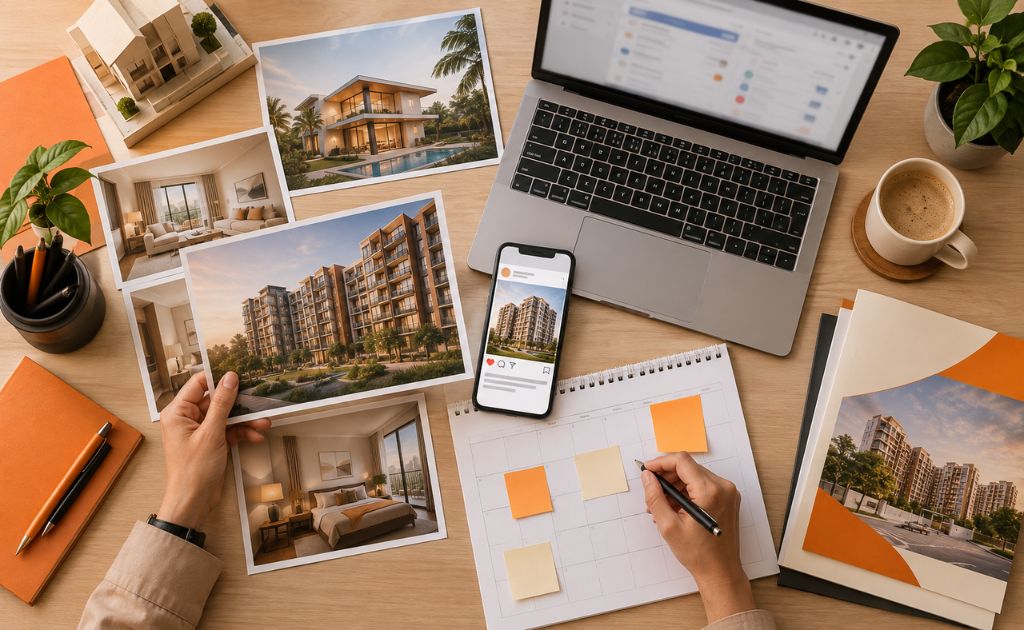
Which of these you use, and in what proportion, depends on the project type, inventory stage, ticket size, market and sales capacity. Treat this as a menu, not a checklist.
1. Real Estate SEO
Real estate SEO means making your project pages, locality pages and helpful content visible for the searches buyers actually type: “2 BHK flats in Sholinganallur”, “villa projects near ECR”, “ready to move apartments Tambaram”, “is [locality] good for investment”.
For builders, that usually means one well-built page per project (with configuration, price band or “price on request”, approvals, RERA number, amenities, location advantages and a clear enquiry path), supported by locality guides and buyer FAQs. For realtors, it means area pages and listing pages that answer comparison questions.
SEO is slow to start but compounds. It suits developers with multiple projects, established brands and anyone who wants leads that arrive with their own intent rather than an ad prompt. It is not the right tool for a 30-day launch push. A structured programme covers keyword research by locality and project, on-page and technical work on project pages, local SEO and link building, reviewed against enquiries rather than rankings alone.
2. Google Ads for Real Estate
Google Search ads capture people who are already looking. The mechanics that matter in property are different from general lead generation:
- Campaign structure by project and by locality, not one city-wide campaign, so budgets and messages match intent.
- Tight geographic targeting around the micro-market and the areas buyers of that project typically come from, with radius and location-of-interest settings reviewed rather than left on defaults.
- Negative keywords for rent, resale, jobs, PG, plots when you sell flats (and vice versa), and unrelated builder names, which otherwise eat a large share of budget.
- Landing page per ad group, with the RERA number and honest pricing signals visible.
- Conversion tracking for form submissions, calls and WhatsApp clicks, so bidding optimises toward enquiries and not just clicks. Google’s own documentation on conversion measurement explains how primary and secondary actions feed bidding.
- Lead form assets can shorten the path on mobile, but the lower friction can also lower quality, so they need a qualification step afterwards.
Google Ads suits demand capture for any project with active search demand in its locality. For a brand-new township with no search volume yet, it should follow, not lead, the awareness work.
3. Meta Ads for Real Estate
Facebook and Instagram ads create demand and capture it. They are the workhorse of Indian project launches because they can reach a defined locality and income profile with visual creative before anyone has searched.
What works in property specifically: interest and location stacking rather than broad targeting; separate campaigns for lead generation and for remarketing; instant forms with qualifying questions (budget range, preferred configuration, purchase timeline) so a cheaper lead does not become a useless one; click-to-WhatsApp objectives where the sales team can respond quickly; and creative built around the project’s real advantages such as location, price band, possession date and amenities.
Creative testing is where the budget is protected. Rotate walkthrough clips, aerial shots, floor-plan explainers, construction progress and testimonial formats, and let performance decide. In Tamil Nadu, Tamil-language creative often deserves its own test cell alongside English.
4. Real Estate Social Media Marketing
Organic social media for real estate should do three jobs: build trust, answer buyer questions and keep the project in front of undecided leads. It rarely produces bookings by itself, and expecting it to is a common reason social spend feels wasted.
Content that works for builders: construction progress updates, sample flat tours, amenity reveals, customer handover moments, locality explainers, and team or founder videos that put a face on the brand. Content that works for realtors and brokers: locality knowledge, honest comparisons, market updates, quick reels answering questions like “what does UDS mean” or “what to check before buying a plot”.
A structured approach to social media marketing for real estate brands starts with audience research and a content calendar, then measures saves, shares, profile visits and enquiries rather than follower counts.
5. Property Video Marketing
Video removes doubt faster than any other format. Buyers want to see the road to the project, the actual site, the sample flat, the view from the balcony and the neighbourhood. Useful formats include project walkthroughs, drone footage, amenity tours, construction updates, customer testimonials, locality drives and short-form explainers on pricing or payment plans.
Video belongs at every stage: reels for awareness, YouTube walkthroughs for research, retargeting clips for comparison, and pre-visit videos that reduce site-visit no-shows.
6. Project Landing Pages That Convert
Sending paid traffic to a homepage is one of the most expensive mistakes in property marketing. A project landing page should contain: project name and RERA registration details, location and map, configurations and price signal, approvals and possession timeline, three to five real visuals, builder credibility, a short enquiry form, click-to-call and click-to-WhatsApp buttons, and a brochure download.
Keep the form short but add one or two qualifying questions. Consider OTP verification if junk enquiries are a problem. Make the page fast on mobile, where a large share of property research happens.
7. Local SEO and Google Business Profile
For builders with a sales office or an experience centre, and for every realtor, a verified Google Business Profile with accurate categories, photos, posts and reviews is a low-cost source of local enquiries. Buyers routinely search “[builder name] reviews” and “[project name] location” before visiting; a maintained profile answers those searches on your terms.
8. WhatsApp and CRM Lead Nurturing
In India, WhatsApp is where property conversations happen. A lead that gets a brochure, location pin and a qualification question on WhatsApp within minutes is far easier to convert to a visit than one that gets a call two days later.
A practical setup uses the WhatsApp Business Platform connected to a CRM, so every enquiry is logged with its source, assigned to a pre-sales caller, and followed by a defined sequence: acknowledgement, brochure, qualification questions, site-visit invitation, reminder, post-visit follow-up. Opt-in and message frequency need to respect platform rules and the buyer’s patience.
The CRM is not optional. Without it, you cannot know which campaign produced the visits and bookings, and you cannot stop duplicate leads from portals, ads and walk-ins being counted three times.
9. Remarketing
Because decisions take weeks, remarketing is where property campaigns earn back their awareness spend. Build audiences from project-page visitors, video viewers, brochure downloaders, form starters who did not submit, and (with consent) CRM lists of open leads. Serve them stage-appropriate messages: construction progress for the undecided, limited-inventory notes for the shortlisted, and payment-plan explainers for those who visited but did not book.
10. Content Marketing for Property Buyers
Buyer-education content earns search visibility and builds the trust that ads cannot buy. Locality guides, “how to check RERA registration”, home-loan eligibility explainers, comparison articles between configurations, and plot-versus-apartment guides all serve real questions. For developers, this content also gives remarketing something worth showing.
11. NRI Property Marketing
Non-resident buyers are a meaningful segment for many Chennai and Tamil Nadu projects. Reaching them means separate campaigns targeting the countries your buyers actually come from (the Gulf, Singapore, the US and the UK are common), messaging that addresses remote buying concerns (virtual site visits, power of attorney, payment and repatriation questions), follow-up scheduled to their time zone, and video that substitutes for the visit they cannot make this month. Keep NRI campaigns in their own budget and reporting line, because their cost and conversion patterns differ from domestic buyers.
12. Analytics and Conversion Tracking
Every channel above needs the same measurement backbone: conversion tracking on forms, calls and WhatsApp clicks; UTM parameters on every link; Google Analytics 4 key events for enquiries and brochure downloads (Google explains key events here); and a CRM that records source, qualification outcome, site visit and booking against each lead. Without this, “which channel works” is a matter of opinion.
Digital Marketing for Builders vs Realtors
The strategies are shared; the emphasis is not. Understanding the difference stops builders from running agent-style campaigns and stops agents from over-investing in project-style infrastructure.
| Factor | Builder / Developer | Realtor / Broker / Agent |
| Primary goal | Sell project inventory within a launch and sustenance window | Generate a steady flow of buyer and seller enquiries across listings |
| Campaign structure | Project-based, phased (pre-launch, launch, sustenance, possession) | Listing- and locality-based, always-on |
| Landing pages | One strong page per project | Area pages and listing pages |
| Key channels | Meta Ads, Google Search, YouTube, remarketing, portals, NRI campaigns | Local SEO, Google Business Profile, Instagram, Google Search, referrals |
| Lead nurturing | Long; CRM and WhatsApp sequences over weeks or months | Often shorter; speed and personal follow-up matter most |
| Creative | Project-led: walkthroughs, amenities, progress | Personality- and locality-led: expertise, comparisons, market updates |
| Success metric | Cost per site visit, cost per booking, inventory velocity | Cost per qualified enquiry, closed deals, repeat and referral share |
Commercial real estate follows the builder pattern but with smaller, more targeted audiences (business owners, investors, corporate real estate teams), a stronger role for LinkedIn and email, and longer evaluation cycles. Plotted developments and villa projects tend to attract investor and NRI interest, which changes the messaging toward appreciation, documentation and approvals rather than lifestyle.
Best online advertising for real estate agents
For an individual agent or small brokerage with a limited budget, the practical priority order is usually: a complete Google Business Profile and reviews, a simple locality-focused website, consistent Instagram and YouTube content that shows real expertise, and only then paid search or Meta campaigns around specific listings. Paid ads amplify a reputation; they do not replace one.
How to Generate Better Real Estate Leads Online
If you are asking how to generate real estate leads online without drowning the sales team in junk, work through these six levers in order.
- Intent before reach. Prioritise channels and keywords where the buyer has expressed location and budget intent (search, locality-specific content, remarketing) before broad awareness targeting.
- Targeting that matches the project. Micro-market geography, income and interest layers, language, and exclusion of audiences that cannot buy (renters, job seekers, out-of-band budgets).
- Qualification inside the form. Budget range, configuration, timeline and purpose (own use or investment) as form fields or WhatsApp questions. Expect fewer leads and a better contact rate.
- A landing page that answers the first five questions. Where, how much, when, who is building it, and is it approved.
- Follow-up within minutes, not days. Speed of first response is the single most controllable factor in lead-to-site-visit conversion.
- Track to the visit and the booking. Feed qualification and visit outcomes back into the ad platforms and reporting, so budget shifts toward sources that produce visits rather than form fills.
Notion Graffiti’s guide to choosing a lead generation partner goes deeper into how a qualified lead should be defined and reported across industries.
Real Estate Digital Marketing Ideas You Can Use This Quarter
Each of these real estate digital marketing ideas is described by what it does, who it suits and when to use it, so you can pick rather than copy.
- Locality landing pages and guides. Capture “flats in [area]” searches and give remarketing something useful. Suits developers with multiple projects and any realtor. Use when you have an SEO horizon of six months or more.
- Project walkthrough video with a “how to reach” segment. Replaces the first site visit for out-of-town and NRI buyers and reduces no-shows. Suits every project. Use from launch onward.
- Construction-progress reels and monthly update posts. The most trusted content a builder can publish; reassures existing buyers and nudges undecided ones. Suits under-construction projects. Use every month.
- Buyer FAQ series (RERA, UDS, carpet vs built-up, loan eligibility). Wins search visibility and pre-empts objection calls. Suits developers and agents alike. Use as evergreen content.
- Google Search campaigns per project and configuration. Captures active demand at the right price. Suits projects in localities with search demand. Use during launch and sustenance.
- Meta lead campaigns with qualifying questions. Creates demand at scale for launches. Suits mid-segment and affordable projects. Use in pre-launch and launch bursts.
- Click-to-WhatsApp campaigns with a qualification flow. Converts curiosity into conversation fast. Suits teams with responsive pre-sales. Use when call pickup rates are low.
- Remarketing sequences by stage. Re-engages page visitors, video viewers and open CRM leads. Suits every project. Use continuously.
- Downloadable brochure and cost-sheet gating. Trades value for contact details and signals seriousness. Suits all projects; keep the file current and RERA-compliant.
- NRI-specific campaigns and webinars. Reaches diaspora buyers with remote-buying answers. Suits villa, plotted and premium projects. Use around festival seasons and holiday travel windows when NRIs plan visits.
- Customer testimonial and handover videos. Proof of delivery, which matters more than amenities for first-time buyers. Suits builders with completed projects. Use in sustenance phase and on the builder brand page.
- Comparison content (project vs locality alternatives, flat vs plot). Meets buyers in the comparison stage with honest information. Suits confident developers and knowledgeable agents.
- Interactive project pages (unit availability, floor-plan selector, EMI calculator). Keeps buyers on your site rather than portals. Suits developers with a web development budget.
- Tamil-language creative cells. Tests whether regional-language messaging lifts contact rates in specific micro-markets. Suits Tamil Nadu projects; run as a controlled test.
Metrics That Matter: Measuring Real Estate Marketing Beyond Clicks
Impressions, clicks and cost per lead tell you whether ads are being delivered. They say nothing about whether homes are being sold. The measurement chain for property should run:
Impressions → Clicks → Leads → Qualified Leads → Site Visits → Bookings → Revenue
The metrics worth reporting every week, explained conceptually:
| Metric | What it tells you |
| Cost per lead (CPL) | Ad efficiency only. Useful for spotting creative or targeting problems, dangerous as a goal on its own |
| Lead-to-contact rate | Whether leads are real and reachable; falls when forms are too easy or targeting is too broad |
| Cost per qualified lead (CPQL) | The first number that reflects business value; requires a shared definition of “qualified” |
| Contact-to-site-visit rate | The quality of pre-sales follow-up and the strength of the project’s proposition |
| Cost per site visit | The most useful marketing efficiency metric for most projects |
| Site-visit-to-booking rate | Primarily a sales and pricing metric, but affected by how well marketing set expectations |
| Cost per booking | Total marketing spend divided by bookings; the number the finance team cares about |
| Source-level and campaign-level ROI | Which channels and campaigns produced bookings, not just leads |
| Pipeline value | Qualified leads and scheduled visits multiplied by average ticket size; shows momentum before bookings land |
Benchmarks vary enormously by city, segment, ticket size and inventory stage, so treat any “industry average” with caution. What matters is your own trend and the comparison between your sources.
Advertising Compliance: Keeping Property Campaigns RERA-Aware
This is not legal advice, and a marketing agency is not a substitute for your legal team. But every Indian property marketer should know two points from the Real Estate (Regulation and Development) Act, 2016, as explained in the Ministry of Housing and Urban Affairs FAQ on RERA: a promoter is required to register a project with the state authority before advertising, marketing, booking or selling in it, and advertisements and prospectuses for registered projects are expected to carry the registration details and the authority’s website.
In Tamil Nadu, the regulator is the Tamil Nadu Real Estate Regulatory Authority, which maintains public registers of registered projects and agents that buyers can (and do) check.
Practically, that means campaign claims about pricing, approvals, possession dates, offers, amenities and appreciation should be reviewed against the registered project details before they go live, landing pages and brochures should carry the registration information, and “pre-launch” marketing should be discussed with your legal advisor before any budget is spent. Platform policies from Google and Meta apply on top of this, particularly around misleading claims.
Where AI and Automation Help (and Where They Don’t)
AI tools now help with creative variations, ad copy drafts, first-response chat on WhatsApp and websites, lead scoring based on engagement, and reporting. Used well, they make a small marketing team faster and make follow-up more consistent.
They do not verify project facts, ensure compliance, replace the pre-sales call that reads a buyer’s real intent, or build the trust that gets a family to a site on a Sunday. Treat AI as an assistant to the process described in this guide, not a replacement for it.
Common Real Estate Digital Marketing Mistakes
- Optimising for the cheapest lead. Cheap leads that never answer the phone cost more than expensive ones that visit.
- Sending all traffic to the homepage. Buyers want the project, not the corporate brand.
- One campaign for the whole city. Location intent is the whole point of property search.
- No qualifying questions. Every lead looks the same until pre-sales wastes a day finding out.
- Slow or inconsistent follow-up. Leads cool within hours, not weeks.
- No CRM, or a CRM nobody updates. Attribution becomes guesswork and duplicates inflate every number.
- Weak landing pages. Missing RERA details, no pricing signal, no map, slow on mobile.
- No remarketing. Paying to reach a buyer once and then letting a competitor finish the conversation.
- Measuring clicks instead of visits and bookings. The dashboard looks fine while inventory sits unsold.
- Ignoring NRI and regional-language segments that may be a large share of actual buyers.
- Copying US real estate marketing advice built for individual agents and MLS listings rather than Indian project sales.
How Much Does Real Estate Digital Marketing Cost?
There is no single answer, and any page that gives you one number without knowing your project is guessing. Two costs need to be separated:
- Advertising spend, paid to Google, Meta, YouTube or portals, which scales with how many leads and visits you need, the competitiveness of the locality, the ticket size and the launch timeline.
- Agency or team fees, which cover strategy, campaign management, creative, landing pages, SEO, content, social media, CRM and WhatsApp setup, reporting and optimisation.
Factors that move the total: number of projects and configurations, inventory stage (pre-launch bursts cost more than sustenance), how much creative and video production is needed, whether landing pages and CRM integration exist already, the level of SEO and content work, campaign duration, and whether NRI or multi-city targeting is involved.
The right question is not “what does it cost” but “what does a qualified site visit cost us, and what does a booking cost us, from each source”. Once you measure that, budget decisions become far simpler.
How to Choose a Real Estate Digital Marketing Agency
Whether you are talking to a specialist real estate digital marketing agency, a full-service agency or a freelancer, evaluate the same things. The list below is what property businesses should assess, and it applies to any agency, including ours.
Industry understanding. Can they explain the difference between marketing a pre-launch project and a ready-to-move one, or between a builder and a broker, without prompting?
Strategy before channels. Do they start by asking about inventory, ticket size, localities, sales capacity and launch dates, or do they lead with a package?
Definition of a qualified lead. Ask them to define it in writing, and ask whether they optimise for site visits or only for form fills.
Paid media competence. How do they structure Google and Meta campaigns for a project, handle negative keywords, test creative and set up conversion tracking?
SEO approach. Do they understand project pages, locality content and local SEO, and are they honest about timelines?
Landing pages and creative. Will they build project-specific pages, and can they produce or coordinate video and design?
Follow-up systems. How do they connect leads to your CRM and WhatsApp workflow, and will they help you improve pre-sales response?
Reporting. Do reports show cost per qualified lead, site visits and bookings by source, or only impressions and CPL?
Ownership and transparency. Who owns the ad accounts, the pixel data, the landing pages and the creative if you part ways? Is ad spend billed separately from fees?
Compliance awareness. Do they route claims about pricing, approvals and possession through your team for review before publishing?
Communication. Who is your day-to-day contact, how fast do they respond during a launch, and how often do you review performance together?
Questions to ask before you sign
- Have you worked with property businesses, and what did you learn that changed your approach?
- How do you define a qualified lead for a project like ours?
- Do you optimise campaigns for site visits, or for form submissions?
- How do you track and report lead quality, site visits and bookings by source?
- How would you structure Google and Meta campaigns for our project and localities?
- What is your SEO plan and realistic timeline for our project and locality pages?
- Who builds the landing pages, and what will they include?
- How do you handle CRM integration and WhatsApp follow-up?
- What does your monthly report contain, and can we see a sample?
- Who owns the ad accounts, data and creative assets?
- How do you handle claims that need compliance review?
An agency that answers these clearly, even where the honest answer is “we would need to build that with you”, is usually a safer choice than one that promises a number of leads before understanding the project.
How Notion Graffiti Supports Real Estate Marketing
Notion Graffiti is a creative digital marketing agency in Chennai. We work across SEO, paid and performance marketing, social media marketing, content, web development, video production, graphic design, email and WhatsApp marketing, which are the same building blocks the strategy in this guide relies on: locality and project SEO, Google and Meta campaigns with proper tracking, project landing pages, walkthrough and progress video, and follow-up systems that connect enquiries to your sales team.
We do not claim to be a real-estate-only agency. What we bring to property clients is a lead-quality-first approach, honest reporting that goes past cost per lead, and local Chennai market understanding, including Tamil-language creative and micro-market targeting. If your current campaigns produce enquiries but not site visits, that is usually where the conversation starts.
Frequently Asked Questions
What is digital marketing for real estate?
It is the use of search, paid ads, social media, video, landing pages, WhatsApp and analytics to create demand for a property or project, capture enquiries, qualify them, drive site visits and support sales through to booking. Unlike general digital marketing, it is measured on site visits and bookings rather than traffic and cost per lead.
How do real estate companies generate leads online?
Mainly through Google Search ads on locality and configuration keywords, Meta lead and click-to-WhatsApp campaigns targeted by micro-market, SEO on project and locality pages, property portal listings, remarketing, and video content that builds trust. Lead quality depends on targeting, qualifying questions and follow-up speed more than on any single channel.
Which is better for real estate: SEO or paid ads?
Neither on its own. Paid search and Meta campaigns deliver launch-phase volume quickly; SEO builds durable demand for the brand and its localities. Most developers run both, weighted toward paid during launches and toward SEO and content during sustenance. For a general comparison, see our SEO vs Google Ads guide.
How does social media marketing help real estate?
Social media builds trust and keeps a project visible during a long decision cycle. Construction updates, walkthroughs, testimonials and locality content help undecided buyers move toward a site visit. It rarely produces bookings on its own and should be judged on engagement, enquiries and assisted conversions, not follower counts.
What is the best online advertising for real estate agents?
For individual agents and small brokerages, a verified Google Business Profile with reviews, locality-focused content on Instagram and YouTube, and targeted Google Search campaigns around specific listings usually deliver the best return. Meta campaigns work well for specific listings and open-house style events once the agent’s online reputation is established.
How do you convert real estate leads into site visits?
Respond within minutes, ideally on WhatsApp with a brochure and location pin; ask qualifying questions about budget, configuration and timeline; offer specific visit slots rather than “whenever convenient”; send reminders with directions and a short pre-visit video; and follow up after no-shows. Track the contact-to-visit rate by source so campaigns can be tuned toward sources that actually visit.
How can real estate businesses target NRI buyers?
Run separate campaigns targeting the countries your buyers come from, use messaging that addresses remote purchase concerns (virtual visits, documentation, payments), schedule follow-up to their time zone, and rely heavily on video. Keep NRI campaigns in their own budget and reporting line because their costs and conversion patterns differ from domestic campaigns.
How does WhatsApp marketing help real estate?
It shortens response time, delivers brochures and location details instantly, allows qualification questions in a low-pressure format, and supports reminders and nurturing over weeks. Connected to a CRM, it also gives you a record of every conversation by lead source. Opt-in and message frequency need to follow platform rules.
How much does real estate digital marketing cost?
It depends on ad spend (which scales with lead and visit targets, locality competition and ticket size) and agency or team fees (strategy, campaign management, creative, landing pages, SEO, content, CRM setup and reporting). The two should always be quoted separately. Judge cost by cost per qualified lead, cost per site visit and cost per booking rather than by monthly fee alone.
What should I look for in a real estate digital marketing agency?
Property understanding, a written definition of a qualified lead, optimisation toward site visits, competence across Google and Meta campaigns and SEO, project-specific landing pages, CRM and WhatsApp integration, reporting that reaches bookings by source, clear ownership of ad accounts and data, and a process for reviewing compliance-sensitive claims.
Conclusion: Market the Journey, Not Just the Project
Digital marketing for real estate succeeds when it is designed around how people actually buy property: slowly, locally, with family, after research, and only after a visit. That means matching channels to funnel stages, qualifying leads before the sales team touches them, building follow-up systems that respond in minutes, keeping campaigns compliant, and measuring all the way to site visits and bookings.
If you are planning a launch, trying to fix a campaign that produces enquiries but no visits, or evaluating whether to bring in a real estate digital marketing agency, start with the funnel and metrics in this guide, then decide which channels deserve budget. If you would like a second opinion on your current setup, the Notion Graffiti team is happy to talk through it.
Recent Comments