Many business owners face the same challenge.
Marketing budgets are limited. Competition keeps increasing. Customers expect instant answers. And AI-powered search experiences are changing how people discover brands.
So where should you invest?
SEO vs Google Ads
Choosing incorrectly can delay growth and waste valuable resources.
Choosing correctly can create a predictable pipeline of leads and long-term profitability.
The answer depends on your goals, timeline, competition, and available budget.
For most businesses in 2026, the smartest answer is not one or the other.
It is a strategic combination of both.
Table of Contents
What Is the Difference Between SEO and Google Ads?
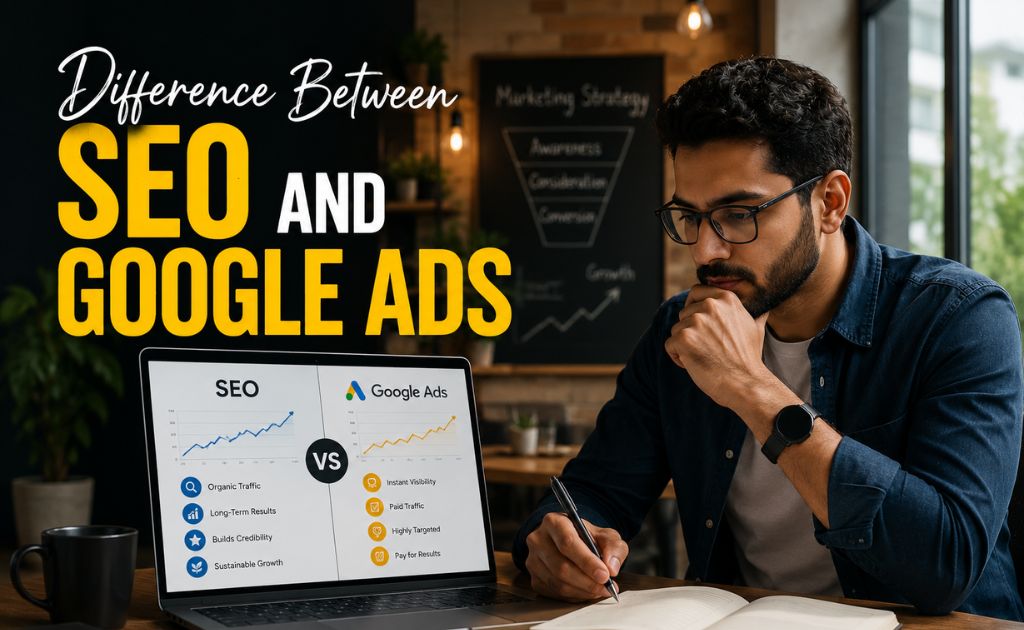
Search Engine Optimization (SEO) focuses on improving your website so it appears organically in search results.
Google Ads allows businesses to pay for immediate visibility through sponsored placements.
Both aim to generate customers.
But they operate very differently.
| Factor | SEO | Google Ads |
|---|---|---|
| Traffic Source | Organic | Paid |
| Time to Results | 3–12 months | Immediate |
| Cost Structure | Upfront investment | Pay per click |
| Long-Term Value | High | Stops when spending stops |
| Trust Levels | Generally higher | Depends on industry |
| Scalability | Compounding | Budget-dependent |
| AI Search Visibility | Strong | Limited |
SEO vs Google Ads at a Glance
Choose SEO if you want:
- Sustainable lead generation
- Lower long-term acquisition costs
- Local authority
- Better visibility in AI search experiences
- Stronger brand trust
Choose Google Ads if you want:
- Immediate enquiries
- Fast testing of new offers
- Seasonal campaigns
- Short-term promotions
- Rapid market entry
Choose Both if you want:
- Predictable growth
- Balanced risk
- Strong market dominance
- Better conversion data
- Long-term profitability
For most businesses, combining both channels produces the best outcomes.
Cost Comparison: SEO vs Google Ads
Budgets vary by industry and location.
The following table reflects common patterns for businesses.
| Business Type | Typical Monthly SEO Investment | Typical Monthly Google Ads Spend |
|---|---|---|
| Interior Designer | ₹20,000–₹60,000 | ₹30,000–₹80,000 |
| Construction Company | ₹30,000–₹1,00,000 | ₹50,000–₹2,00,000 |
| Spa & Wellness | ₹20,000–₹50,000 | ₹25,000–₹70,000 |
| Aesthetic Clinic | ₹40,000–₹1,50,000 | ₹75,000–₹3,00,000 |
| Manufacturer | ₹30,000–₹80,000 | ₹40,000–₹1,50,000 |
| Logistics Firm | ₹25,000–₹70,000 | ₹50,000–₹2,00,000 |
The critical difference is this:
SEO investments continue generating value after implementation.
Google Ads stop producing results when budgets stop.
Timeline Comparison
| Objective | SEO | Google Ads |
|---|---|---|
| First Leads | 2–6 months | Days |
| Brand Awareness | 6–12 months | Immediate |
| Local Authority | Long-term | Limited |
| Reduced CAC | Strong | Challenging |
| Market Testing | Moderate | Excellent |
| Business Stability | Excellent | Budget dependent |
Businesses expecting overnight SEO results often become disappointed.
Businesses relying entirely on paid ads often become trapped in rising acquisition costs.
The strongest companies balance both.
ROI Analysis: Which Delivers Better Returns?
ROI depends heavily on business maturity.
Early-Stage Businesses
Google Ads typically generate faster returns because visibility is immediate.
Established Businesses
SEO often produces better long-term economics because traffic continues without paying for every click.
The Compounding Effect of SEO
Imagine a clinic spending ₹50,000 monthly on ads.
If advertising stops, enquiries stop.
Now imagine the same clinic investing consistently in SEO for 18 months.
High-ranking service pages, local visibility, reviews, and authoritative content can continue producing leads long after the original investment.
That compounding effect is why SEO becomes more profitable over time.
The Notion Graffiti Growth Framework
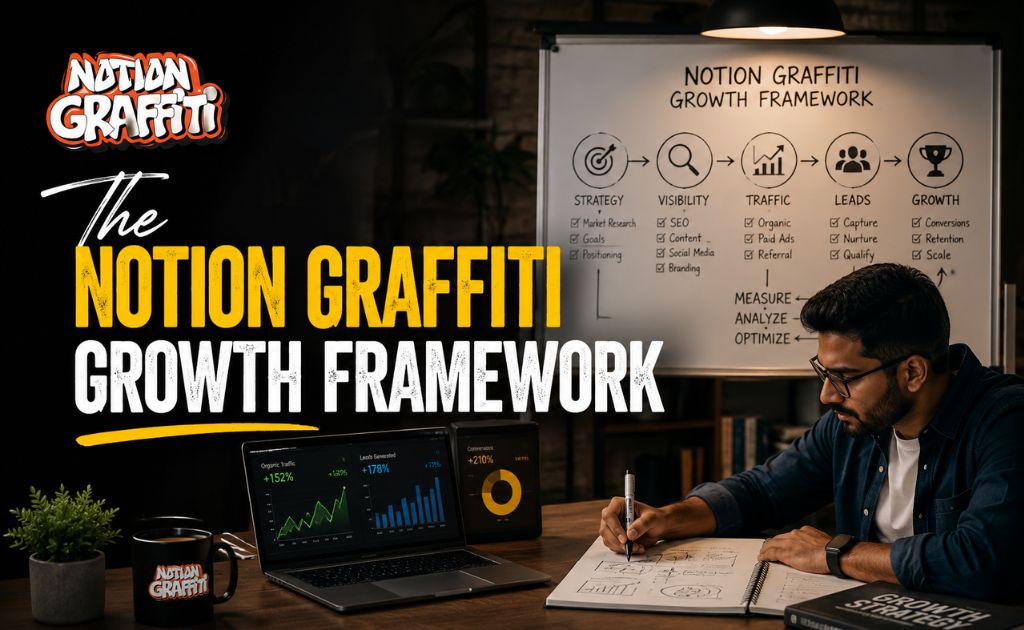
We recommend a simple decision model.
Stage 1: Need Leads Immediately
Use:
- Google Ads
- Conversion-focused landing pages
- Call tracking
- Remarketing
Stage 2: Build Organic Foundations
Invest in:
- Local SEO
- Service pages
- Content clusters
- Technical optimization
- Internal linking
Stage 3: Create Market Dominance
Combine:
- SEO
- Google Ads
- AI Search optimization
- Local authority
- Conversion rate optimization
This balanced approach reduces risk while increasing visibility across multiple channels.
When Should Businesses Choose SEO?
SEO is usually the better investment when:
You Want Sustainable Growth
Organic rankings continue delivering traffic long after publication.
Your Industry Depends on Trust
Businesses such as clinics, construction firms, and manufacturers benefit from educational content and authority signals.
You Want Better AI Search Visibility
AI assistants increasingly cite authoritative websites with strong content ecosystems.
SEO investments help businesses become discoverable beyond traditional search results.
You Operate Locally
Businesses targeting customers in Chennai often gain significant advantages through local SEO, Google Business optimization, reviews, and localized service pages.
When Should Businesses Choose Google Ads?
Google Ads make sense when:
You Need Leads This Month
Immediate campaigns can fill short-term demand.
You Are Testing New Services
Ads provide fast feedback on offers and pricing.
Your Business Is Seasonal
Interior projects, festive promotions, educational admissions, and wellness campaigns often benefit from short-term advertising pushes.
Competition Is Extremely High
Paid visibility may be necessary while SEO efforts mature.
Why Most Businesses Should Use SEO and Google Ads Together
The strongest growth strategy combines both.
Google Ads provide speed.
SEO provides sustainability.
Together, they create:
- More brand visibility.
- Better keyword intelligence.
- Stronger conversion rates.
- Lower acquisition costs over time.
- Greater resilience during market changes.
Businesses that integrate both channels often outperform competitors focused exclusively on one approach.
Industry Examples
Interior Designers
An interior design company launching a new service can use Google Ads for immediate enquiries while building SEO authority through:
- Project portfolios
- Location pages
- Design trend content
- Cost guides
Eventually, organic leads reduce dependency on paid campaigns.
Construction Companies
Construction firms benefit enormously from long-term SEO investments.
Decision cycles are lengthy.
Trust matters.
Authority matters.
Service pages, case studies, and educational content often outperform pure advertising strategies over time.
Spas and Wellness Businesses
Spas can use Google Ads for seasonal offers while investing in local SEO, review generation, and neighborhood-specific landing pages.
The combination produces stronger retention and lower acquisition costs.
Clinics and Aesthetic Centers
Healthcare decisions involve research.
Patients compare providers, treatments, pricing, and expertise.
SEO supports educational journeys, while ads capture immediate demand.
Both channels complement each other.
Manufacturers
Manufacturers targeting B2B customers often experience stronger long-term returns from SEO because buyers conduct extensive research before purchasing.
Technical content, product pages, and industry resources become powerful assets.
Logistics Firms
Logistics businesses frequently compete on geography and reliability.
Local SEO and service-specific content establish trust, while Google Ads support urgent transportation requirements and new market expansion.
AI Search Changes the Conversation
The rise of AI-powered discovery means businesses must think beyond traditional rankings.
Large language models increasingly prioritize:
- Clear explanations.
- Structured content.
- Strong entities.
- Verified expertise.
- Comprehensive topic coverage.
SEO contributes significantly to AI discoverability.
Paid advertisements, by contrast, generally have limited visibility within AI-generated answers.
Businesses investing in authoritative content today are positioning themselves for future search behavior.
Expert Recommendation
If your budget allows only one channel:
- Choose Google Ads for immediate revenue needs.
- Choose SEO for long-term market leadership.
If your budget supports growth:
Use both.
That combination offers the strongest balance between speed, sustainability, authority, and profitability.
Final Conclusion: SEO vs Google Ads in 2026
The question is not:
“Which is better?”
The better question is:
“What does my business need right now, and how do I build sustainable growth for the future?”
For most businesses, the answer is:
Start with Google Ads for speed. Build SEO for long-term dominance. Combine both for the best results.
Ready to Build a Sustainable Growth Engine?
Notion Graffiti helps businesses combine:
- SEO Services
- Local SEO
- AI Search Optimization
- Conversion-focused websites
- Content marketing
- Google Ads support
Whether you operate an interior design firm, construction company, clinic, manufacturing business, logistics company, or wellness brand, a balanced growth strategy can reduce acquisition costs while increasing long-term visibility.
Book a consultation to build a search strategy designed for sustainable growth rather than short-term spikes.
FAQs
Is SEO better than Google Ads for small businesses?
SEO generally provides stronger long-term returns, while Google Ads deliver faster results. Most businesses benefit from using both.
How long does SEO take compared to Google Ads?
Google Ads can generate leads within days. SEO typically requires several months to build momentum.
Which is cheaper: SEO or Google Ads?
SEO usually becomes more cost-effective over time because organic traffic continues after implementation, whereas ads require ongoing spending.
Should local businesses invest in SEO?
Yes. Local SEO improves visibility in maps, local searches, and increasingly within AI-powered search experiences.
Can Google Ads help SEO rankings?
Google Ads do not directly improve organic rankings, but campaign insights can help businesses identify high-converting keywords for SEO efforts.
Is SEO still worth it in the age of AI search?
Absolutely. High-quality, authoritative content remains one of the strongest signals for AI retrieval systems and traditional search engines.
Recent Comments